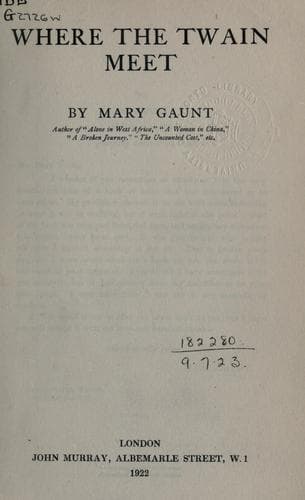
Black people -- Jamaica; Jamaica; Slavery -- Jamaica
Philip, who was “Able,” is now “infirm,” and Pope, who only has one
hand, is now “Able and Ill-dispos'd,” and no mention is made of an
infirmity which certainly must severely handicap a slave.
And so it goes on. Villian is “Subject to Fits,” and Solomon is “subject
to Bone ach,” a long list which makes us feel for the weary men and
women who must turn out into the field at the blowing of the conch
shell.
If you have any imagination at all there are many little pathetic
histories in a slave book.
There was Dolly on Worthy Park Estate, entered in 1787 as in the
overseer's house. She had a baby, Mulatto Patty, in all probability the
daughter of the overseer. If she was he goes away and leaves her a
slave on the plantation, for she is entered every year to the end of the
record as “healthy, but too young to work.” Work is all that is expected
of the white man's daughter. Poor little Patty! Her mother's two next
children are presumably black, as their colour is not mentioned, which
it would have been had they had any white blood in their veins; and
presently poor Dolly is a field-labourer again, fallen from her high
estate. For in Jamaica the house-servant ranks high in the social scale.
That is why, I think, that the house-servants in Jamaica generally wear
a handkerchief over their heads. The white bondservants did so because
it was the custom of the time, and the black woman promoted from the
field put a kerchief over her head and wore it as a sign of her higher
social standing. The custom is dying hard, and it is a pity it should
die at all, for the negro woman's hair is not her strong point and it is
better covered.
Then Fogo, also in the overseer's house, had a boy named Charles Dale,
and Charles Dale is the blacksmith upon the estate, but there is no
record of little Charles being freed. In truth the father never counted.
In a record of forty births on Worthy Park never once is he mentioned.
The births are put down on one side of the page as “Increase of the
Negroes,” and the baby is only mentioned because he is an asset, as he
takes turn with the notice that so many negroes have been bought. On the
other side of the page is invariably “Increase of Stock,” kept on
exactly the same lines.
In the Rose Hall slave books, thirty years later in date, the births
are put casually among the daily occurrences, just as the runaways are
mentioned, or the fact that a certain runaway “Cæsar” or “Arabella”
is “brought home.” And, perhaps, in the whole pitiful list in all the
books, the only entry that looks well is that Betty Madge on Worthy Park
has many young children and does not work.
The last man who makes entries in this book is rather fond of a gentle
reproach. I don't like him, and I don't think the negroes could have
liked him either, though I only judge by the handwriting and his brief
remarks.
Public-domain text, read in full here on John Shaqi.
Reviews
Reviews
No reviews yet
Be the first to share your thoughts on this work.
Elsewhere in the archive
Join the Discussion
Join the discussion
Sign in to leave a comment or review.
Sign InorCreate an account