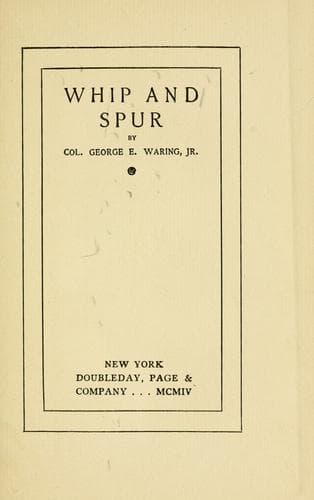
Fox hunting; Horses; United States -- History -- Civil War, 1861-1865 -- Personal narratives
Finally, one lovely Sunday morning, I found her sitting on her haunches
like a dog, patient and gentle, and wondering at her pain. She remained
in this position all day, refusing food. I stroked her velvet crest,
and coaxed her with sugar. She rubbed her nose against my arm, and was
evidently thankful for my caresses, but she showed no disposition to
rise. The adjutant led me into my tent as he would have led me from the
bedside of a dying friend. I turned to look back at poor Vixen, and she
gave me a little neigh of farewell.
They told me then, and they told it very tenderly, that there was no
possibility that she could get well in camp, and that they wanted me
to give her over to them. The adjutant sat by me, and talked of the
old days when I had had her at home, and when he had known her well.
We brought back all of her pleasant ways, and agreed that her trouble
ought to be ended.
As we talked, a single shot was fired, and all was over. The setting
sun was shining through the bare November branches, and lay warm in
my open tent-front. The band, which had been brought out for the only
funeral ceremony, breathed softly Kreutzer's touching "Die Kapelle,"
and the sun went down on one of the very sad days of my life.
The next morning I carved deeply in the bark of a great oak-tree, at
the side of the Pacific Railroad, beneath which they had buried my
lovely mare, a simple VIX; and some day I shall go to scrape the moss
from the inscription.
RUBY.
I was a colonel commanding a regiment of German cavalrymen in South
Missouri, and must have a horse; it was desirable to be conspicuously
well mounted, and so it must be a showy horse; being a heavy weight and
a rough rider, it must be a good horse. With less rank, I might have
been compelled to take a very ordinary mount and be content: my vanity
would not have availed me, and my rough riding must have ceased.
But I was chief ruler of the little world that lay encamped on the
beautiful banks of the Roubie d'Eaux; and probably life was easier to
all under me when I was satisfied and happy. I am not conscious of
having been mean and crabbed, or of favoring those who favored me to
the disadvantage of those who did not. I cannot recall an instance of
taking a bribe, even in the form of a pleasant smile. It was probably
easier, in the long run, to be fair than to be unfair, and therefore
the laziest private ever ordered on extra duty could not lay his hand
on his heart and say he thinks it was done because he was not diligent
in foraging for turkeys and hens for my private mess. I had very early
in life been impressed with the consciousness that the way of the
transgressor is not easy; and as I wanted my way to be easy, I fell
into the way of not transgressing.
Public-domain text, read in full here on John Shaqi.
Reviews
Reviews
No reviews yet
Be the first to share your thoughts on this work.
Join the Discussion
Join the discussion
Sign in to leave a comment or review.
Sign InorCreate an account