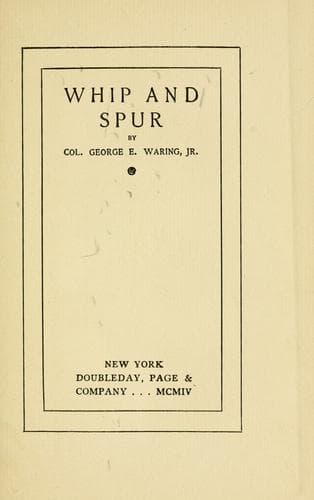
Fox hunting; Horses; United States -- History -- Civil War, 1861-1865 -- Personal narratives
We lay on the marvellous Roubie d'Eaux, at its source; no such
babbling brook as trickles from the hillside springs of New England,
but a roaring torrent, breaking at once from a fathomless vent in the
mountain. The processes of formation with these South Missouri rivers
are all hidden from sight, but, far away in the topmost caves of the
Ozark hills, the little streamlets trickle, and unite for a larger and
ever larger flow, gorging at last the huge caverns of the limestone
rock and bursting upon the world a full-grown river. Within our camp
this wonderful spring broke forth, and close at hand was a large
grist-mill that it drove. We were a self-sustaining community,--in
this, that we foraged our own corn and ground our own meal. With
similar industry we provided ourselves with fish, flesh, and fowl.
The trees were bare with the November frosts, but the Indian summer had
come, and, day after day, it bathed every twig and spray with its amber
breath, warming all nature to a second life, and floating the remoter
hills far away into a hazy dreamland.
But personally, notwithstanding all this, I was not content: I was
practically a dismounted cavalryman. Indeed, it would even have been
a pity to see a colonel of infantry riding such brutes as fell to my
lot, for good weight-carriers were rare in that section. I had paid a
very high price for a young thoroughbred stallion (afterwards, happily,
sold for a large advance), only to find him a year too young for his
work, and the regiment had been scoured in vain for an available mount.
I would have gone any reasonable length, even in injustice, to secure
such an animal as was needed. It was not easy to make up one's mind to
order a soldier to give up a horse he was fond of, and some soldier had
an especial fondness for all but the worthless brutes. My reluctance to
do this was perhaps not lessened by the fact that it was forbidden for
officers to ride United States horses. It finally became evident that
the chances were very small of ever finding a suitable animal, and I
even went out, on one shooting excursion, mounted on a mule.
Up to this time the regiment had been all that could be asked, but
now it seemed to contain a thousand ill-tempered, sore-headed men.
The whole camp was awry. Some of the officers intimated that this was
all the fault of the adjutant; that the orders from headquarters had
lately been unusually harsh. This officer, when remonstrated with,
insisted that he had only transmitted the exact orders given him, and I
knew that my own action had always been reasonable,--on principle so.
Sometimes one almost wished himself back in civil life, away from such
constant annoyances.
Public-domain text, read in full here on John Shaqi.
Reviews
Reviews
No reviews yet
Be the first to share your thoughts on this work.
Join the Discussion
Join the discussion
Sign in to leave a comment or review.
Sign InorCreate an account