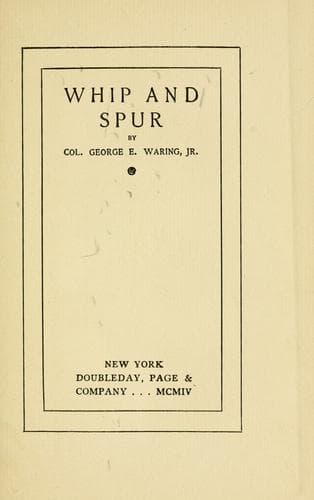
Fox hunting; Horses; United States -- History -- Civil War, 1861-1865 -- Personal narratives
I took Ruby, my best horse. He was a sure reliance under all
circumstances, and he and I knew each other perfectly. We were at home
in every foot-path in the country, having had many a summer's swim in
this very river; and now, accompanied only by Wettstein and Klitschka,
I went on to the ferry-boat. It was what is known as a "swing" ferry. A
stout rope is stretched between trees on the opposite shores, and the
boat is attached to a couple of pulleys arranged to traverse the length
of this rope. The attaching cords--one at each end of the up-stream
side of the boat--are long enough to allow it to swing some rods down
the stream; by shortening one of the ropes and lengthening the other,
the boat is placed at an angle with the swift current, which propels it
toward one shore or the other, the pulleys keeping pace in their course
on the main rope.
The main rope was rough from long use, and often the pulleys would
halt in their course, until the pull of the advancing boat dragged them
free. Then the rickety craft, shivering from end to end, would make a
rapid shoot, until another defective place in the rope brought her to
again. At each vibration, the horses nearly lost their feet, and the
surging stream almost sent its muddy water over the gunwale. It was a
long and anxious trip,--the rotten guy-rope hardly serving to hold us
to our course. At last we reached the shore and rode on to Craikill's
house in the Bottom. He had been "conscripted," and forced to go with
the army, so his wife told us, and she had seen him march with the rest
on the Fairview Road for Little Rock. The last bird had flown, and we
could safely march back at our leisure.
Wettstein filled his pipe, emptied his haversack for the benefit of
Craikill's hungry children, and, cheery as ever, followed me to the
ferry. On the way over he had been as still as a mouse, for he was too
old a soldier to give an enemy any sign of our approach. But, as we
set out on the return trip, in the cold moonlight, he sang the "Ranz
des Vaches," fondled his little mare, and, unmindful of his wounded
arm, gave way to the flow of spirits that the past few days' duty had
checked. I never knew him more gay and delightful; and, as we stood
leaning on our saddles and chatting together, I congratulated myself
upon the possession of such a perpetual sunbeam.
Public-domain text, read in full here on John Shaqi.
Reviews
Reviews
No reviews yet
Be the first to share your thoughts on this work.
Join the Discussion
Join the discussion
Sign in to leave a comment or review.
Sign InorCreate an account