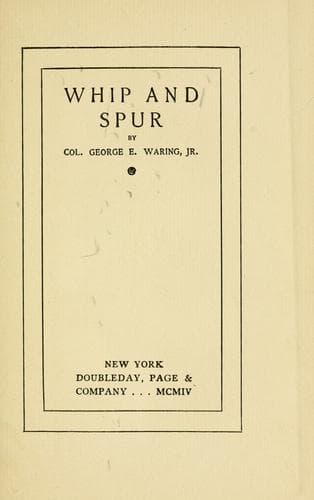
Fox hunting; Horses; United States -- History -- Civil War, 1861-1865 -- Personal narratives
Union City was not a city at all; it was hardly a village, and
"Disunion" would have been its fairer designation. It lay in the woods
at the crossing of two railroads, one pointing toward Mobile and one
toward Memphis, but neither leading anywhere. There was a tradition
that trains had once been run upon each, but many bridges had had to be
rebuilt to make the short line to Columbus passable, and the rest was
ruin; for Forrest had been there with his cavalry.
The land was just so much raised above the broad swamp of Northwestern
Tennessee that whiskey with men to drink it, and a Methodist Church
South with people to attend it, were possible. With these meagre
facilities for life, and the vague inducement of a railroad-crossing.
Union City had struggled into an amphibious subsistence; but it had
never thriven, and its corner-lots had but feebly responded to the
hopes of its projectors.
For many a mile around, the forests and swamps were well-nigh
impenetrable, and the occasional clearings were but desolate oases
in the waste of marsh and fallen timber. The roads were wood-trails
leading nowhere in particular, and all marked a region of the most
scanty and unfulfilled promise.
General Asboth, seeing (by the map) that it commanded two lines of
railroad, sent us to occupy this strategic point, and we gradually
accumulated to the number of twenty-five hundred cavalry and four
thousand infantry, drawing our regular supplies from Columbus;
and occupying our time with a happy round of drills, inspections,
horse-races, cock-fights, and poker. It was not an elevating existence,
but it was charmingly idle, and we passed the serene and lovely autumn
of 1863 in a military dreamland, where nothing ever came to disturb
our quiet, or to mar our repose with the realities of war. We built
ourselves houses, we shot game for our tables, we made egg-nog for our
evenings, and we were happy. The charm of camp-life--with just enough
of occupation and responsibility, and with enough improvement in the
troops for a reward--made even this wilderness enjoyable. I had the
advantage of seniority and command, and the physical comforts that
naturally gravitate toward a commanding officer did not fail me.
Public-domain text, read in full here on John Shaqi.
Reviews
Reviews
No reviews yet
Be the first to share your thoughts on this work.
Join the Discussion
Join the discussion
Sign in to leave a comment or review.
Sign InorCreate an account