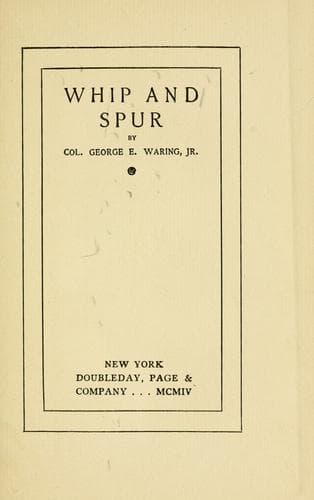
Fox hunting; Horses; United States -- History -- Civil War, 1861-1865 -- Personal narratives
The first days of our march in Mississippi were through Tippah County,
as rough, hopeless, God-forsaken a country as was ever seen outside
of Southern Missouri. Its hills were steep, its mud was deep, its
houses and farms were poor, its facilities for the subsistence of a
protecting army like ours were of the most meagre description, and
its streams delayed us long with their torrents of bottomless muddy
water, fast swelling from the thaw that had unlocked the snow of all
the deep-buried hills and morasses of their upper waters. We built
ferry-boats and swamped them, built bridges and broke them, and slowly
and painfully, horse by horse, transferred the command across the nasty
riverbeds. Tippah Creek detained us and kept us hard at work all day
and all night, and we reached the Tallahatchee at New Albany barely in
time to ford our last man across before it rose to an impassable depth.
And then for two days we pressed forward, in company with the whole
column, through the rough, rocky, and wooded country, reaching Okolona
only at nightfall.
Here we struck the marvellous prairie region of Northeastern
Mississippi, literally a land flowing with milk and honey. An
interminable, fertile, rolling prairie lay before us in every
direction. The stern rule of the Confederacy had compelled the planters
to offset every small field of cotton with a wide area of corn, until
the region had become known as the granary of the Southern army.
Not only must every land-owner devote his broadest fields to the
cultivation of the much-needed cereal, but one tenth of all his crop
must be stacked for public use in cribs at the side of the railroad.
Public-domain text, read in full here on John Shaqi.
Reviews
Reviews
No reviews yet
Be the first to share your thoughts on this work.
Join the Discussion
Join the discussion
Sign in to leave a comment or review.
Sign InorCreate an account