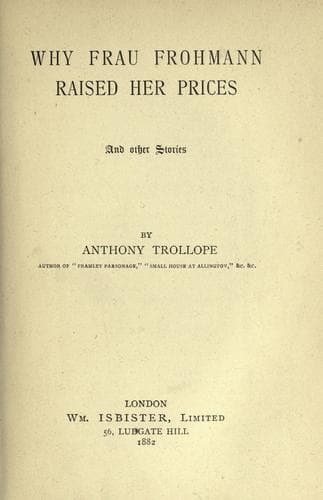
Why Frau Frohmann Raised Her Prices, and Other StoriesTrollope, Anthony
General
Why Frau Frohmann Raised Her Prices, and Other Stories
Trollope, Anthony
English fiction -- 19th century; Manners and customs -- Fiction; Short stories, English
He paused a moment, and then he answered her very seriously, standing up
and looking down upon her as he did so. “For very much--with me. I do
not think that I could have brought myself to choose a wife, whatever
might have been a woman’s charms, except among ladies. I found this one
to be the chosen companion and dearest friend of the finest lady I
know.” At this the old woman, old as she was, first blushed, and then,
finding herself to be sobbing, turned her face away from him. “I came
across a girl of whose antecedents I could be quite sure, of whose
bringing up I knew all the particulars, as to whom I could be certain
that every hour of her life had been passed among the best possible
associations. I heard testimony as to her worth and her temper which I
could not but believe. As to her outward belongings, I had eyes of my
own to judge. Could I be wrong in asking such a one to be my wife? Can I
be regarded as unhappy in having succeeded with her? Could I be
acquitted of dishonour if I were to desert her? Shall I be held to be
contemptible if I am true to her?”
At every word he spoke he grew in her esteem. At this present crisis of
her life she did not wish to think specially well of him, though he was
her son, but she could not help herself. He became bigger before her
than he had ever been before, and more of a man. It was, she felt,
almost vain for a woman to lay her commands, either this way or that,
upon a man who could speak to her as Philip had spoken.
But not the less was the power in her hands. She could bid him go and
marry--and be a beggar. She could tell him that all Launay should go to
his brother, and she could instantly make a will to that effect. So
strong was the desire for masterdom upon her that she longed to do it.
In the very teeth of her honest wish to do what was right, there was
another wish--a longing to do what she knew to be wrong. There was a
struggle within, during which she strove to strengthen herself for evil.
But it was vain. She knew of herself that were she to swear to-day to
him that he was disinherited, were she to make a will before nightfall
carrying out her threat, the pangs of conscience would be so heavy
during the night that she would certainly change it all on the next
morning. Of what use is a sword in your hand if you have not the heart
to use it? Why seek to be turbulent with a pistol if your bosom be of
such a nature that your finger cannot be forced to pull the trigger?
Power was in her possession--but she could not use it. The power rather
was in her hands. She could not punish her boy, even though he had
deserved it. She had punished her girl, and from that moment she had
been crushed by torments, because of the thing that she had done. Others
besides Mrs. Miles have felt, with something of regret, that they have
lacked the hardness necessary for cruelty and the courage necessary for
its doing.
Public-domain text, read in full here on John Shaqi.
Reviews
Reviews
No reviews yet
Be the first to share your thoughts on this work.
Elsewhere in the archive
Join the Discussion
Join the discussion
Sign in to leave a comment or review.
Sign InorCreate an account