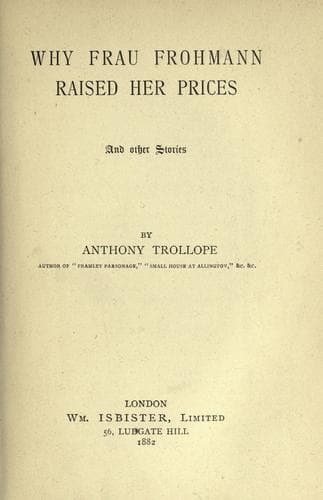
Why Frau Frohmann Raised Her Prices, and Other StoriesTrollope, Anthony
General
Why Frau Frohmann Raised Her Prices, and Other Stories
Trollope, Anthony
English fiction -- 19th century; Manners and customs -- Fiction; Short stories, English
“How shall it be, mother?” asked Philip. As she knew not what to answer
she rose slowly from her chair, and leaving the room went to the
seclusion of her own chamber.
Days again passed before Philip renewed his question, and repeated it in
the same words: “How shall it be, mother?” Wistfully she looked up at
him, as though even yet something might be accorded by him to pity; as
though the son might even yet be induced to accede to his mother’s
prayers. It was not that she thought so. No. She had thought much, and
was aware that it could not be so. But as a dog will ask with its eyes
when it knows that asking is in vain, so did she ask. “One word from
you, mother, will make us all happy.”
“No; not all of us.”
“Will not my happiness make you happy?” Then he stooped over her and
kissed her forehead. “Could you be happy if you knew that I were
wretched?”
“I do not want to be happy. It should be enough that one does one’s
duty.”
“And what is my duty? Can it be my duty to betray the girl I love in
order that I may increase an estate which is already large enough?”
“It is for the family.”
“What is a family but you, or I, or whoever for the moment may be its
representative? Say that it shall be as I would have it, and then I will
go to her and let her know that she may come back to your arms.”
Not then, or on the next day, or on the next, did she yield; though she
knew well during all these hours that it was her fate to yield. She had
indeed yielded. She had confessed to herself that it must be so, and as
she did so she felt once more the soft pressure of Bessy’s arms as they
would cling round her neck, and she could see once more the brightness
of Bessy’s eyes as the girl would hang over her bed early in the
morning. “I do not want to be happy,” she had said; but she did want,
sorely want, to see her girl. “You may go and tell her,” she said one
night as she was preparing to go to her chamber. Then she turned quickly
away, and was out of the room before he could answer her with a word.
CHAPTER XI.
HOW BESSY PRYOR RECEIVED HER LOVER.
Miss Gregory was certainly surprised when, on the entrance of the young
man, Bessy jumped from her chair and rushed into his arms. She knew that
Bessy had no brother, and her instinct rather than her experience told
her that the greeting which she saw was more than fraternal,--more than
cousinly. She did not doubt but that the young man was Philip Launay,
and knowing what she knew she was not disposed to make spoken
complaints. But when Bessy lifted her face to be kissed, Miss Gregory
became red and very uneasy. It is probable that she herself had never
progressed as far as this with the young man who afterwards became the
major-general.
Public-domain text, read in full here on John Shaqi.
Reviews
Reviews
No reviews yet
Be the first to share your thoughts on this work.
Elsewhere in the archive
Join the Discussion
Join the discussion
Sign in to leave a comment or review.
Sign InorCreate an account