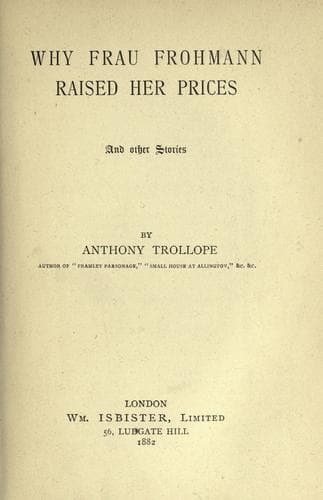
Why Frau Frohmann Raised Her Prices, and Other StoriesTrollope, Anthony
General
Why Frau Frohmann Raised Her Prices, and Other Stories
Trollope, Anthony
English fiction -- 19th century; Manners and customs -- Fiction; Short stories, English
We all know how people under a cloud are apt to fail in asserting their
personal dignity. On the former day a separate vehicle had been ordered
by Mr. Brown to take himself and his wife to the station, but now, after
his misfortunes, he contented himself with such provision as the people
at the hotel might make for him. At the appointed hour he brought his
wife down, thickly veiled. There were many strangers as she passed
through the hall, ready to look at the lady who had done that wonderful
thing in the dead of night, but none could see a feature of her face as
she stepped across the hall, and was hurried into the omnibus. And there
were many eyes also on Mr. Jones, who followed very quickly, for he
also, in spite of his sufferings, was leaving Paris on the evening in
order that he might be with his English friends on Christmas Day. He, as
he went through the crowd, assumed an air of great dignity, to which,
perhaps, something was added by his endeavours, as he walked, to save
his poor throat from irritation. He, too, got into the same omnibus,
stumbling over the feet of his enemy in the dark. At the station they
got their tickets, one close after the other, and then were brought into
each other’s presence in the waiting-room. I think it must be
acknowledged that here Mr. Jones was conscious, not only of her
presence, but of her consciousness of his presence, and that he assumed
an attitude, as though he should have said, “Now do you think it
possible for me to believe that you mistook me for your husband?” She
was perfectly quiet, but sat through that quarter of an hour with her
face continually veiled. Mr. Brown made some little overture of
conversation to Mr. Jones, but Mr. Jones, though he did mutter some
reply, showed plainly enough that he had no desire for further
intercourse. Then came the accustomed stampede, the awful rush, the
internecine struggle in which seats had to be found. Seats, I fancy, are
regularly found, even by the most tardy, but it always appears that
every British father and every British husband is actuated at these
stormy moments by a conviction that unless he proves himself a very
Hercules he and his daughters and his wife will be left desolate in
Paris. Mr. Brown was quite Herculean, carrying two bags and a hat-box in
his own hands, besides the cloaks, the coats, the rugs, the sticks, and
the umbrellas. But when he had got himself and his wife well seated,
with their faces to the engine, with a corner seat for her,--there was
Mr. Jones immediately opposite to her. Mr. Jones, as soon as he
perceived the inconvenience of his position, made a scramble for another
place, but he was too late. In that contiguity the journey as far as
Calais had to be made. She, poor woman, never once took up her veil.
There he sat, without closing an eye, stiff as a ramrod, sometimes
showing by little uneasy gestures that the trouble at his neck was still
there, but never speaking a word, and hardly moving a limb.
Public-domain text, read in full here on John Shaqi.
Reviews
Reviews
No reviews yet
Be the first to share your thoughts on this work.
Elsewhere in the archive
Join the Discussion
Join the discussion
Sign in to leave a comment or review.
Sign InorCreate an account