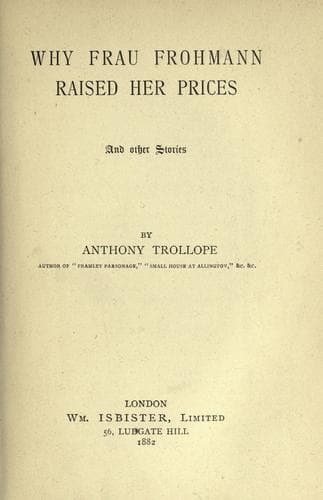
Why Frau Frohmann Raised Her Prices, and Other StoriesTrollope, Anthony
General
Why Frau Frohmann Raised Her Prices, and Other Stories
Trollope, Anthony
English fiction -- 19th century; Manners and customs -- Fiction; Short stories, English
Crossing from Calais to Dover the lady was, of course, separated from
her victim. The passage was very bad, and she more than once reminded
her husband how well it would have been with them now had they pursued
their journey as she had intended,--as though they had been detained in
Paris by his fault! Mr. Jones, as he laid himself down on his back, gave
himself up to wondering whether any man before him had ever been made
subject to such absolute injustice. Now and again he put his hand up to
his own beard, and began to doubt whether it could have been moved, as
it must have been moved, without waking him. What if chloroform had been
used? Many such suspicions crossed his mind during the misery of that
passage.
They were again together in the same railway carriage from Dover to
London. They had now got used to the close neighbourhood, and knew how
to endure each the presence of the other. But as yet Mr. Jones had never
seen the lady’s face. He longed to know what were the features of the
woman who had been so blind--if indeed that story were true. Or if it
were not true, of what like was the woman who would dare in the middle
of the night to play such a trick as that? But still she kept her veil
close over her face.
From Cannon Street the Browns took their departure in a cab for the
Liverpool Street Station, whence they would be conveyed by the Eastern
Counties Railway to Stratford. Now at any rate their troubles were over.
They would be in ample time, not only for Christmas Day church, but for
Christmas Day breakfast. “It will be just the same as getting in there
last night,” said Mr. Brown, as he walked across the platform to place
his wife in the carriage for Stratford. She entered it the first, and as
she did so there she saw Mr. Jones seated in the corner! Hitherto she
had borne his presence well, but now she could not restrain herself
from a little start and a little scream. He bowed his head very
slightly, as though acknowledging the compliment, and then down she
dropped her veil. When they arrived at Stratford, the journey being over
in a quarter of an hour, Jones was out of the carriage even before the
Browns.
“There is Uncle John’s carriage,” said Mrs. Brown, thinking that now, at
any rate, she would be able to free herself from the presence of this
terrible stranger. No doubt he was a handsome man to look at, but on no
face so sternly hostile had she ever before fixed her eyes. She did not,
perhaps, reflect that the owner of no other face had ever been so deeply
injured by herself.
CHAPTER V.
MRS. BROWN AT THOMPSON HALL.
“Please, sir, we were to ask for Mr. Jones,” said the servant, putting
his head into the carriage after both Mr. and Mrs. Brown had seated
themselves.
“Mr. Jones!” exclaimed the husband.
“Why ask for Mr. Jones?” demanded the wife. The servant was about to
tender some explanation when Mr. Jones stepped up and said that he was
Mr. Jones. “We are going to Thompson Hall,” said the lady with great
vigour.
Public-domain text, read in full here on John Shaqi.
Reviews
Reviews
No reviews yet
Be the first to share your thoughts on this work.
Elsewhere in the archive
Join the Discussion
Join the discussion
Sign in to leave a comment or review.
Sign InorCreate an account