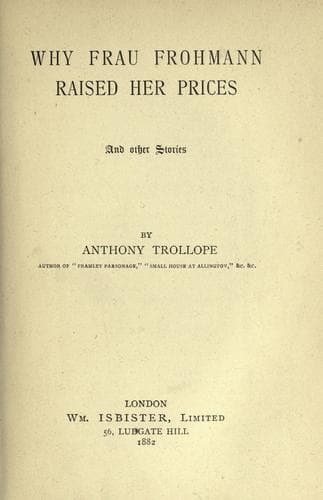
Why Frau Frohmann Raised Her Prices, and Other StoriesTrollope, Anthony
General
Why Frau Frohmann Raised Her Prices, and Other Stories
Trollope, Anthony
English fiction -- 19th century; Manners and customs -- Fiction; Short stories, English
“My brother,” said she, throwing her arms round him and kissing him. He
recoiled from the embrace, but I think that he attempted to return the
kiss. “And now I will tell the whole story,” said Mrs. Brown. And she
told it, acknowledging her fault with true contrition, and swearing
that she would atone for it by life-long sisterly devotion.
“And you mustard-plastered the wrong man!” said the old gentleman,
almost rolling off his chair with delight.
“I did,” said Mrs. Brown, sobbing, “and I think that no woman ever
suffered as I suffered.”
“And Jones wouldn’t let you leave the hotel?”
“It was the handkerchief stopped us,” said Brown.
“If it had turned out to be anybody else,” said the member of
Parliament, “the results might have been most serious,--not to say
discreditable.”
“That’s nonsense, Robert,” said Mrs. Brown, who was disposed to resent
the use of so severe a word, even from the legislator cousin.
“In a strange gentleman’s bedroom!” he continued. “It only shows that
what I have always said is quite true. You should never go to bed in a
strange house without locking your door.”
Nevertheless it was a very jovial meeting, and before the evening was
over Mr. Jones was happy, and had been brought to acknowledge that the
mustard-plaster would probably not do him any permanent injury.
THE TELEGRAPH GIRL.
CHAPTER I.
LUCY GRAHAM AND SOPHY WILSON.
Three shillings a day to cover all expenses of life, food, raiment,
shelter, a room in which to eat and sleep, and fire and light,--and
recreation if recreation there might be,--is not much; but when Lucy
Graham, the heroine of this tale, found herself alone in the world, she
was glad to think that she was able to earn so much by her work, and
that thus she possessed the means of independence if she chose to be
independent. Her story up to the date with which we are dealing shall be
very shortly told. She had lived for many years with a married brother,
who was a bookseller in Holborn,--in a small way of business, and
burdened with a large family, but still living in decent comfort. In
order, however, that she might earn her own bread she had gone into the
service of the Crown as a “Telegraph Girl” in the Telegraph Office.[A]
And there she had remained till the present time, and there she was
earning eighteen shillings a week by eight hours’ continual work daily.
Her life had been full of occupation, as in her spare hours she had been
her brother’s assistant in his shop, and had made herself familiar with
the details of his trade. But the brother had suddenly died, and it had
been quickly decided that the widow and the children should take
themselves off to some provincial refuge.
Public-domain text, read in full here on John Shaqi.
Reviews
Reviews
No reviews yet
Be the first to share your thoughts on this work.
Elsewhere in the archive
Join the Discussion
Join the discussion
Sign in to leave a comment or review.
Sign InorCreate an account