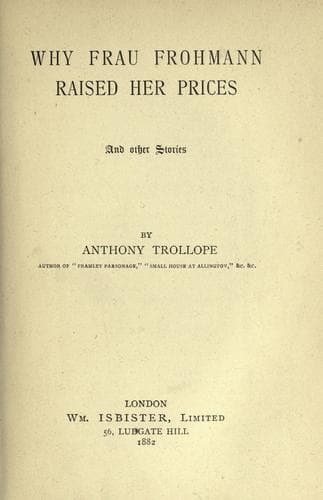
Why Frau Frohmann Raised Her Prices, and Other StoriesTrollope, Anthony
General
Why Frau Frohmann Raised Her Prices, and Other Stories
Trollope, Anthony
English fiction -- 19th century; Manners and customs -- Fiction; Short stories, English
Then it was that Lucy Graham had to think of her independence and her
eighteen shillings a week on the one side, and of her desolation and
feminine necessities on the other. To run backwards and forwards from
High Holborn to St. Martin’s-le-Grand had been very well as long as she
could comfort herself with the companionship of her sister-in-law and
defend herself with her brother’s arm;--but how would it be with her if
she were called upon to live all alone in London? She was driven to
consider what else she could do to earn her bread. She might become a
nursemaid, or perhaps a nursery governess. Though she had been well and
in some respects carefully educated, she knew that she could not soar
above that. Of music she did not know a note. She could draw a little
and understood enough French,--not to read it, but to teach herself to
read it. With English literature she was better acquainted than is usual
with young women of her age and class; and, as her only personal
treasures, she had managed to save a few books which had become hers
through her brother’s kindness. To be a servant was distasteful to her,
not through any idea that service was disreputable, but from a dislike
to be subject at all hours to the will of others. To work and work hard
she was quite willing, so that there might be some hours of her life in
which she might not be called upon to obey.
When, therefore, it was suggested to her that she had better abandon the
Telegraph Office and seek the security of some household, her spirit
rebelled against the counsel. Why should she not be independent, and
respectable, and safe? But then the solitude! Solitude would certainly
be hard, but absolute solitude might not perhaps be necessary. She was
fond too of the idea of being a government servant, with a sure and
fixed salary,--bound of course to her work at certain hours, but so
bound only for certain hours. During a third of the day she was, as she
proudly told herself, a servant of the Crown. During the other
two-thirds she was lord,--or lady,--of herself.
But there was a quaintness, a mystery, even an awe, about her
independence which almost terrified her. During her labours she had
eight hundred female companions, all congregated together in one vast
room, but as soon as she left the Post Office she was to be all alone!
For a few months after her brother’s death she continued to live with
her sister-in-law, during which time this great question was being
discussed. But then the sister-in-law and the children disappeared, and
it was incumbent on Lucy to fix herself somewhere. She must begin life
after what seemed to her to be a most unfeminine fashion,--“just as
though she were a young man,”--for it was thus that she described to
herself her own position over and over again.
Public-domain text, read in full here on John Shaqi.
Reviews
Reviews
No reviews yet
Be the first to share your thoughts on this work.
Elsewhere in the archive
Join the Discussion
Join the discussion
Sign in to leave a comment or review.
Sign InorCreate an account