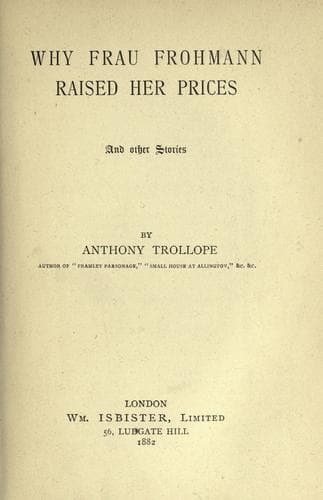
Why Frau Frohmann Raised Her Prices, and Other StoriesTrollope, Anthony
General
Why Frau Frohmann Raised Her Prices, and Other Stories
Trollope, Anthony
English fiction -- 19th century; Manners and customs -- Fiction; Short stories, English
She was one Sophy Wilson by name,--and it was agreed between them that
they should club their means together and hire a room for their joint
use. Here would be a companionship,--and possibly, after awhile, sweet
friendship. Sophy was younger than herself, and might probably need,
perhaps be willing to accept, assistance. To be able to do something
that should be of use to somebody would, she felt, go far towards giving
her life that interest which it would otherwise lack.
When Lucy examined her friend, thinking of the closeness of their future
connection, she was startled by the girl’s prettiness and youth, and
thorough unlikeness to herself. Sophy had long, black, glossy curls,
large eyes, a pink complexion, and was very short. She seemed to have no
inclination for that strong, serviceable brown binding which was so
valuable in Lucy’s eyes; but rather to be wedded to bright colours and
soft materials. And it soon became evident to the elder young woman that
the younger looked upon her employment simply as a stepping-stone to a
husband. To get herself married as soon as possible was unblushingly
declared by Sophy Wilson to be the one object of her ambition,--and as
she supposed that of every other girl in the telegraph department. But
she seemed to be friendly and at first docile, to have been brought up
with aptitudes for decent life, and to be imbued with the necessity of
not spending more than her three shillings a day. And she was quick
enough at her work in the office,--quicker even than Lucy
herself,--which was taken by Lucy as evidence that her new friend was
clever, and would therefore probably be an agreeable companion.
They took together a bedroom in a very quiet street in Clerkenwell,--a
street which might be described as genteel because it contained no
shops; and here they began to keep house, as they called it. Now the
nature of their work was such that they were not called upon to be in
their office till noon, but that then they were required to remain there
till eight in the evening. At two a short space was allowed them for
dinner, which was furnished to them at a cheap rate in a room adjacent
to that in which they worked. Here for eightpence each they could get a
good meal, or if they preferred it they could bring their food with
them, and even have it cooked upon the premises. In the evening tea and
bread and butter were provided for them by the officials; and then at
eight or a few minutes after they left the building and walked home. The
keeping of house was restricted in fact to providing tea and bread and
butter for the morning meal, and perhaps when they could afford it for
the repetition of such comfort later in the evening. There was the
Sunday to be considered,--as to which day they made a contract with the
keeper of the lodging-house to sit at her table and partake of her
dishes. And so they were established.
Public-domain text, read in full here on John Shaqi.
Reviews
Reviews
No reviews yet
Be the first to share your thoughts on this work.
Elsewhere in the archive
Join the Discussion
Join the discussion
Sign in to leave a comment or review.
Sign InorCreate an account