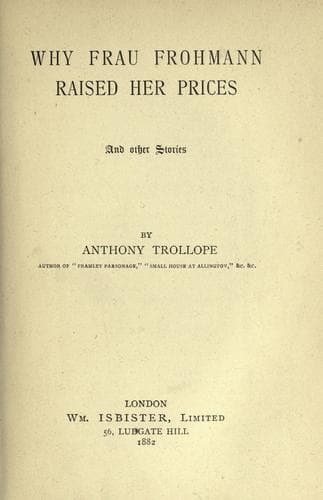
Why Frau Frohmann Raised Her Prices, and Other StoriesTrollope, Anthony
General
Why Frau Frohmann Raised Her Prices, and Other Stories
Trollope, Anthony
English fiction -- 19th century; Manners and customs -- Fiction; Short stories, English
Two years before her brother’s death there had been a suitor for her
hand,--as to whose suit she had in truth doubted much. He also had been
a bookseller, a man in a larger way of business than her brother, some
fifteen years older than herself,--a widower, with a family. She knew
him to be a good man, with a comfortable house, an adequate income, and
a kind heart. Had she gone to him she would not have been required then
to live among the bookshelves or the telegraphs. She had doubted much
whether she would not go to him. She knew she could love the children.
She thought that she could buckle herself to that new work with a will.
But she feared,--she feared that she could not love him.
Perhaps there had come across her heart some idea of what might be the
joy of real, downright, hearty love. If so it was only an idea. No
personage had come across her path thus to disturb her. But the idea, or
the fear, had been so strong with her that she had never been able to
induce herself to become the wife of this man; and when he had come to
her after her brother’s death, in her worst desolation,--when the
prospect of service in some other nursery had been strongest before her
eyes,--she had still refused him. Perhaps there had been a pride in
this,--a feeling that as she had rejected him in her comparative
prosperity, she should not take him now when the renewal of his offer
might probably be the effect of generosity. But she did refuse him; and
the widowed bookseller had to look elsewhere for a second mother for his
children.
Then there arose the question, how and where she should live? When it
came to the point of settling herself, that idea of starting in life
like a young man became very awful indeed. How was she to do it? Would
any respectable keeper of lodgings take her in upon that principle? And
if so, in what way should she plan out her life? Sixteen hours a day
were to be her own. What should she do with them? Was she or was she not
to contemplate the enjoyment of any social pleasures; and if so, how
were they to be found of such a nature as not to be discreditable? On
rare occasions she had gone to the play with her brother, and had then
enjoyed the treat thoroughly. Whether it had been _Hamlet_ at the
Lyceum, or _Lord Dundreary_ at the Haymarket, she had found herself
equally able to be happy. But there could not be for her now even such
rare occasions as these. She thought that she knew that a young woman
all alone could not go to the theatre with propriety, let her be ever so
brave. And then those three shillings a day, though sufficient for life,
would hardly be more than sufficient.
But how should she begin? At last chance assisted her. Another girl,
also employed in the Telegraph Office, with whom there had been some
family acquaintance over and beyond that formed in the office, happened
at this time to be thrown upon the world in some such fashion as
herself, and the two agreed to join their forces.
Public-domain text, read in full here on John Shaqi.
Reviews
Reviews
No reviews yet
Be the first to share your thoughts on this work.
Elsewhere in the archive
Join the Discussion
Join the discussion
Sign in to leave a comment or review.
Sign InorCreate an account