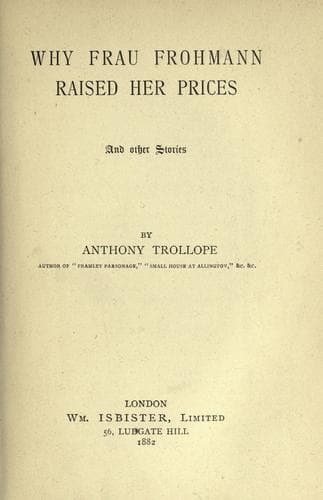
Why Frau Frohmann Raised Her Prices, and Other StoriesTrollope, Anthony
General
Why Frau Frohmann Raised Her Prices, and Other Stories
Trollope, Anthony
English fiction -- 19th century; Manners and customs -- Fiction; Short stories, English
All this had taken place immediately after dinner, which at this period
of the year was eaten at noon. It had simply been a family meal, at
which the Frau had sat with her two children and her two friends. The
kaplan on such occasions was always free. Nothing that he had in that
house ever cost him a kreutzer. But the attorney paid his way like any
one else. When called on for absolute work done,--not exactly for advice
given in conference,--he made his charges. It might be that a time was
coming in which no money would pass on either side, but that time had
not arrived as yet. As soon as the Frau was left alone, she reseated
herself in her accustomed arm-chair, and set herself to work in sober
and almost solemn sadness to think over it all. It was a most perplexing
question. There could be no doubt that all the wealth which she at
present owned had been made by a business carried on at the present
prices and after the existing fashion. Why should there be any change?
She was told that she must make her customers pay more because she
herself was made to pay more. But why should she pay more? She could
understand that in the general prosperity of the Brunnenthal those about
her should have somewhat higher wages. As she had prospered, why should
not they also prosper? The servants of the poor must, she thought, be
poorer than the servants of the rich. But why should poultry be dearer,
and meat? Some things she knew were cheaper, as tea and sugar and
coffee. She had bought three horses during the winter, and they
certainly had been costly. Her father had not given such prices, nor,
before this, had she. But that probably had been Peter’s fault, who had
too rashly acceded to the demands made upon him. And now she remembered
with regret that, on the 1st of January, she had acceded to a petition
from the carpenter for an addition of six zwansigers to his monthly
wages. He had made the request on the plea of a sixth child, adding
also, that journeymen carpenters both at Brixen and at Innsbruck were
getting what he asked. She had granted to the coming of the additional
baby that which she would probably have denied to the other argument;
but it had never occurred to her that she was really paying the
additional four shillings a month because carpenters were becoming
dearer throughout the world. Malchen’s clothes were certainly much more
costly than her own had been, when she was young; but then Malchen was a
foolish girl, fond of fashion from Munich, and just at this moment was
in love. It could hardly be right that those poor Tendel females, with
their small and fixed means, should be made to pay more for their
necessary summer excursions because Malchen would dress herself in
so-called French finery, instead of adhering, as she ought, to Tyrolese
customs.
Public-domain text, read in full here on John Shaqi.
Reviews
Reviews
No reviews yet
Be the first to share your thoughts on this work.
Join the Discussion
Join the discussion
Sign in to leave a comment or review.
Sign InorCreate an account