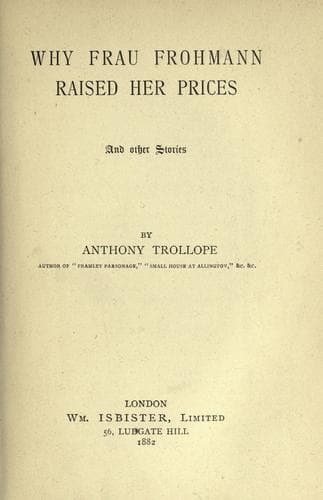
Why Frau Frohmann Raised Her Prices, and Other StoriesTrollope, Anthony
General
Why Frau Frohmann Raised Her Prices, and Other Stories
Trollope, Anthony
English fiction -- 19th century; Manners and customs -- Fiction; Short stories, English
“Yes;” he said;--“about my little boy. I could not say what I had to say
in the street, though I had thought to do so.” Then he paused, and she
sat herself down, feeling, she did not know why, as though she would
lack strength to hear him if she stood. It was then the case that some
particular service was to be demanded from her,--something that would
show his confidence in her. The very idea of this seemed at once to add
a grace to her life. She would have the child to love. There would be
something for her to do. And there must be letters between her and him.
It would certainly add a grace to her life. But how odd that he should
not take his child with him! He had paused a moment while she thought of
all this, and she was aware that he was looking at her. But she did not
dare to return his gaze, or even to glance up at his face. And then
gradually she felt that she was shivering and trembling. What was it
that ailed her,--just now when it would be so necessary that she should
speak out with some strength? She had eaten nothing since her breakfast
when he had come to her, and she was afraid that she would show herself
to be weak. “Will you be his mother?” he said.
What did it mean? How was she to answer him? She knew that his eyes were
on her, but hers were more than ever firmly fixed upon the floor. And
she was aware that she ought briskly to have acceded to his
request,--so as to have shown by her ready alacrity that she had
attributed no other meaning to the words than they had been intended to
convey,--that she had not for a moment been guilty of rash folly. But
though it was so imperative upon her to say a word, yet she could not
speak. Everything was swimming round her. She was not even sure that she
could sit upon her chair. “Lucy,” he said;--then she thought she would
have fallen;--“Lucy, will you be my wife?”
There was no doubt about the word. Her sense of hearing was at any rate
not deficient. And there came upon her at once a thorough conviction
that all her troubles had been changed for ever and a day into joys and
blessings. The word had been spoken from which he certainly would never
go back, and which of course,--of course,--must be a commandment to her.
But yet there was an unfitness about it which disturbed her, and she was
still powerless to speak. The remembrance of the meanness of her clothes
and poorness of her position came upon her,--so that it would be her
duty to tell him that she was not fit for him; and yet she could not
speak.
“If you will say that you want time to think about it, I shall be
contented,” he said. But she did not want a moment to think about it.
She could not have confessed to herself that she had learned to love
him,--oh, so much too dearly,--if it were not for this most unexpected,
most unthought of, almost impossible revelation. But she did not want a
moment to make herself sure that she did love him. Yet she could not
speak. “Will you say that you will think of it for a month?”
Public-domain text, read in full here on John Shaqi.
Reviews
Reviews
No reviews yet
Be the first to share your thoughts on this work.
Elsewhere in the archive
Join the Discussion
Join the discussion
Sign in to leave a comment or review.
Sign InorCreate an account