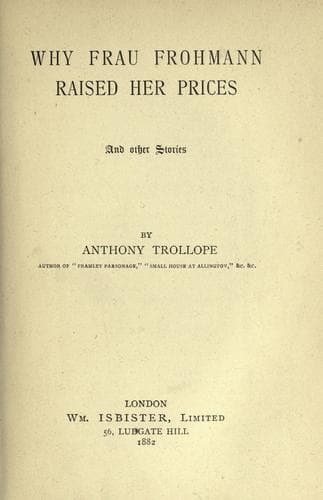
Why Frau Frohmann Raised Her Prices, and Other StoriesTrollope, Anthony
General
Why Frau Frohmann Raised Her Prices, and Other Stories
Trollope, Anthony
English fiction -- 19th century; Manners and customs -- Fiction; Short stories, English
Then there came upon her an idea that he was not asking this because he
loved her, but in order that he might have a mother whom he could trust
for his child. Even that would have been flattering, but that would not
have sufficed. Then when she told herself what she was, or rather what
she thought herself to be, she felt sure that he could not really love
her. Why should such a man as he love such a woman? Then her mouth was
opened. “You cannot want me for myself,” she said.
“Not for yourself! Then why? I am not the man to seek any girl for her
fortune, and you have none.” Then again she was dumfounded. She could
not explain what she meant. She could not say,--because I am brown, and
because I am plain, and because I have become thin and worn from want,
and because my clothes are old and shabby. “I ask you,” he said,
“because with all my heart I love you.”
It was as though the heavens had been opened to her. That he should
speak a word that was not true was to her impossible. And, as it was so,
she would not coy her love to him for a moment. If only she could have
found words with which to speak to him! She could not even look up at
him, but she put out her hand so as to touch him. “Lucy,” he said,
“stand up and come to me.” Then she stood up and with one little step
crept close to his side. “Lucy, can you love me?” And as he asked the
question his arm was pressed round her waist, and as she put up her hand
to welcome rather than to restrain his embrace, she again felt the
strength, the support, and the warmth of his grasp. “Will you not say
that you love me?”
“I am such a poor thing,” she replied.
“A poor thing, are you? Well, yes; there are different ways of being
poor. I have been poor enough in my time, but I never thought myself a
poor thing. And you must not say it ever of yourself again.”
“No?”
“My girl must not think herself a poor thing. May I not say, my girl?”
Then there was just a little murmur, a sound which would have been “yes”
but for the inability of her lips to open themselves. “And if my girl,
then my wife. And shall my wife be called a poor thing? No, Lucy. I have
seen it all. I don’t think I like poor things;--but I like you.”
“Do you?”
“I do. And now I must go back to the City Road and give up charge and
take my money. And I must leave this at seven--after a cup of tea. Shall
I see you again?”
“See me again! Oh, to-day, you mean. Indeed you shall. Not see you off?
My own, own, own man?”
“What will they say at the office?”
“I don’t care what they say. Let them say what they like. I have never
been absent a day yet without leave. What time shall I be here?” Then
he named an hour. “Of course I will have your last words. Perhaps you
will tell me something that I must do.”
“I must leave some money with you.”
Public-domain text, read in full here on John Shaqi.
Reviews
Reviews
No reviews yet
Be the first to share your thoughts on this work.
Elsewhere in the archive
Join the Discussion
Join the discussion
Sign in to leave a comment or review.
Sign InorCreate an account