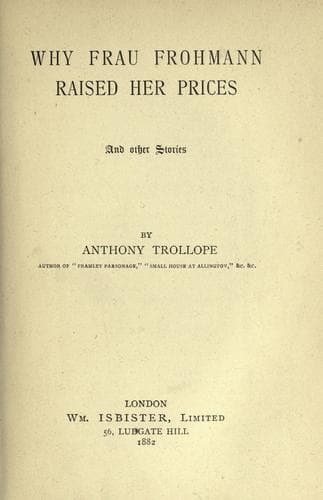
Why Frau Frohmann Raised Her Prices, and Other StoriesTrollope, Anthony
General
Why Frau Frohmann Raised Her Prices, and Other Stories
Trollope, Anthony
English fiction -- 19th century; Manners and customs -- Fiction; Short stories, English
“No; no; no; not yet. That shall come after.” This she said smiling up
at him, with a sparkle of a tear in each eye, but with such a smile!
Then he caught her in his arms and kissed her. “That may come at present
at any rate,” he said. To this, though it was repeated once and again,
there was no opposition. Then in his own masterful manner he put on his
hat and stalked out of the room without any more words.
She must return to the office that afternoon, of course, if only for the
sake of explaining her wish to absent herself the rest of the day. But
she could not go forth into the streets just yet. Though she had been
able to smile at him and to return his caress, and for a moment so to
stand by him that she might have something of the delight of his love,
still she was too much flurried, too weak from the excitement of the
last half-hour, to walk back to the Post Office without allowing herself
some minutes to recruit her strength and collect her thoughts. She went
at once up to her own room and cut for herself a bit of bread which she
began to eat,--just as one would trim one’s lamp carefully for some
night work, even though oppressed by heaviest sorrow, or put fuel on the
fire that would be needed. Then having fed herself, she leaned back in
her chair, throwing her handkerchief over her face, in order that she
might think of it.
Oh,--how much there was to fill her mind with many thoughts! Looking
back to what she had been even an hour ago, and then assuring herself
with infinite delight of the certain happiness of her present position,
she told herself that all the world had been altered to her within that
short space. As for loving him;--there was no doubt about that! Now she
could own to herself that she had long since loved him, even when she
thought that he might probably take that other girl as his wife. That
she should love him,--was it not a matter of course, he being what he
was? But that he should love her,--that, that was the marvel! But he
did. She need not doubt that. She could remember distinctly each word of
assurance that he had spoken to her. “I ask you, because with all my
heart I love you.” “May I not say my girl;--and, if my girl, then my
wife?” “I do not think that I like poor things; but I like you.” No. If
she were regarded by him as good enough to be his wife then she would
certainly never call herself a poor thing again.
Public-domain text, read in full here on John Shaqi.
Reviews
Reviews
No reviews yet
Be the first to share your thoughts on this work.
Elsewhere in the archive
Join the Discussion
Join the discussion
Sign in to leave a comment or review.
Sign InorCreate an account