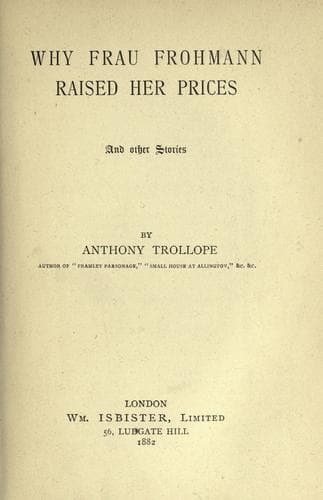
Why Frau Frohmann Raised Her Prices, and Other StoriesTrollope, Anthony
General
Why Frau Frohmann Raised Her Prices, and Other Stories
Trollope, Anthony
English fiction -- 19th century; Manners and customs -- Fiction; Short stories, English
It used to be said in the village of Beetham that nothing ever went
wrong with Alice Dugdale,--the meaning of which, perhaps, lay in the
fact that she was determined that things should be made to go right.
Things as they came were received by her with a gracious welcome, and
“things,” whatever they were, seemed to be so well pleased with the
treatment afforded to them, that they too for most part made themselves
gracious in return.
Nevertheless she had had sorrows, as who has not? But she had kept her
tears for herself, and had shown her smiles for the comfort, of those
around her. In this little story it shall be told how in a certain
period of her life she had suffered much;--how she still smiled, and how
at last she got the better of her sorrow.
Her father was the country doctor in the populous and straggling parish
of Beetham. Beetham is one of those places so often found in the south
of England, half village, half town, for the existence of which there
seems to be no special reason. It had no mayor, no municipality, no
market, no pavements, and no gas. It was therefore no more than a
village;--but it had a doctor, and Alice’s father, Dr. Dugdale, was the
man. He had been established at Beetham for more than thirty years, and
knew every pulse and every tongue for ten miles round. I do not know
that he was very great as a doctor;--but he was a kind-hearted, liberal
man, and he enjoyed the confidence of the Beethamites, which is
everything. For thirty years he had worked hard and had brought up a
large family without want. He was still working hard, though turned
sixty, at the time of which we are speaking. He had even in his old age
many children dependent on him, and though he had fairly prospered, he
had not become a rich man.
He had been married twice, and Alice was the only child left at home by
his first wife. Two elder sisters were married, and an elder brother was
away in the world. Alice had been much younger than they, and had been
the only child living with him when he had brought to his house a second
mother for her. She was then fifteen. Eight or nine years had since
gone, and almost every year had brought an increase to the doctor’s
family. There were now seven little Dugdales in and about the nursery;
and what the seven would do when Alice should go away the folk of
Beetham always declared that they were quite at a loss even to guess.
For Mrs. Dugdale was one of those women who succumb to
difficulties,--who seem originally to have been made of soft material
and to have become warped, out of joint, tattered, and almost useless
under the wear of the world. But Alice had been constructed of
thoroughly seasoned timber, so that, let her be knocked about as she
might, she was never out of repair. Now the doctor, excellent as he was
at doctoring, was not very good at household matters,--so that the folk
at Beetham had reason to be at a loss when they bethought themselves as
to what would happen when Alice should “go away.”
Public-domain text, read in full here on John Shaqi.
Reviews
Reviews
No reviews yet
Be the first to share your thoughts on this work.
Elsewhere in the archive
Join the Discussion
Join the discussion
Sign in to leave a comment or review.
Sign InorCreate an account