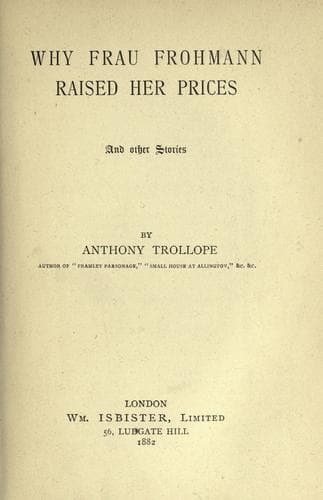
Why Frau Frohmann Raised Her Prices, and Other StoriesTrollope, Anthony
General
Why Frau Frohmann Raised Her Prices, and Other Stories
Trollope, Anthony
English fiction -- 19th century; Manners and customs -- Fiction; Short stories, English
Of course there is always that prospect of a girl’s “going away.” Girls
not unfrequently intend to go away. Sometimes they “go away” very
suddenly, without any previous intention. At any rate such a girl as
Alice cannot be regarded as a fixture in a house. Binding as may be her
duties at home, it is quite understood that should any adequate
provocation to “go away” be brought within her reach, she will go, let
the duties be what they may. Alice was a thoroughly good girl,--good to
her father, good to her little brothers and sisters, unutterably good to
that poor foolish stepmother;--but, no doubt she would “go away” if duly
asked.
When that vista of future discomfort in the doctor’s house first made
itself clearly apparent to the Beethamites, an idea that Alice might
perhaps go very soon had begun to prevail in the village. The eldest son
of the vicar, Parson Rossiter, had come back from India as Major
Rossiter, with an appointment, as some said, of £2,000 a year;--let us
put it down as £1,500;--and had renewed his acquaintance with his old
playfellow. Others, more than one or two, had endeavoured before this to
entice Alice to “go away,” but it was said that the dark-visaged
warrior, with his swarthy face and black beard, and bright
eyes,--probably, too, something in him nobler than those outward
bearings,--had whispered words which had prevailed. It was supposed that
Alice now had a fitting lover, and that therefore she would “go away.”
There was no doubt in the mind of any single inhabitant of Beetham as to
the quality of the lover. It was considered on all sides that he was
fitting,--so fitting that Alice would of course go when asked. John
Rossiter was such a man that every Beethamite looked upon him as a
hero,--so that Beetham was proud to have produced him. In small
communities a man will come up now and then as to whom it is surmised
that any young lady would of course accept him. This man, who was now
about ten years older than Alice, had everything to recommend him. He
was made up of all good gifts of beauty, conduct, dignity, good
heart,--and fifteen hundred a year at the very least. His official
duties required him to live in London, from which Beetham was seventy
miles distant; but those duties allowed him ample time for visiting the
parsonage. So very fitting he was to take any girl away upon whom he
might fix an eye of approbation, that there were others, higher than
Alice in the world’s standing, who were said to grudge the young lady
of the village so great a prize. For Alice Dugdale was a young lady of
the village and no more; whereas there were county families around, with
daughters, among whom the Rossiters had been in the habit of mixing. Now
that such a Rossiter had come to the fore, the parsonage family was held
to be almost equal to county people.
Public-domain text, read in full here on John Shaqi.
Reviews
Reviews
No reviews yet
Be the first to share your thoughts on this work.
Elsewhere in the archive
Join the Discussion
Join the discussion
Sign in to leave a comment or review.
Sign InorCreate an account