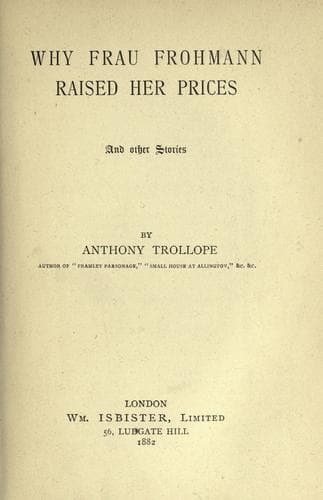
Why Frau Frohmann Raised Her Prices, and Other StoriesTrollope, Anthony
General
Why Frau Frohmann Raised Her Prices, and Other Stories
Trollope, Anthony
English fiction -- 19th century; Manners and customs -- Fiction; Short stories, English
The old parson loved her, and so did Miss Rossiter,--Miss Janet
Rossiter,--who was four or five years older than her brother, and
therefore quite an old maid. But John was so great a man that neither of
them dared to say much to encourage him,--as neither did Mrs. Rossiter
to use her eloquence on the other side. It was felt by all of them that
any persuasion might have on John anything but the intended effect. When
a man at the age of thirty-three is Deputy Assistant Inspector General
of Cavalry, it is not easy to talk him this way or that in a matter of
love. And John Rossiter, though the best fellow in the world, was apt to
be taciturn on such a subject. Men frequently marry almost without
thinking about it at all. “Well; perhaps I might as well. At any rate I
cannot very well help it.” That too often is the frame of mind.
Rossiter’s discussion to himself was of a higher nature than that, but
perhaps not quite what it should have been. “This is a thing of such
moment that it requires to be pondered again and again. A man has to
think of himself, and of her, and of the children which have to come
after him;--of the total good or total bad which may come of such a
decision.” As in the one manner there is too much of negligence, so in
the other there may be too much of care. The “perhaps I might as
wells,”--so good is Providence,--are sometimes more successful than
those careful, long-pondering heroes. The old parson was very sweet to
Alice, believing that she would be his daughter-in-law, and so was Miss
Rossiter, thoroughly approving of such a sister. But Mrs. Rossiter was a
little cold;--all of which Alice could read plainly and digest, without
saying a word. If it was to be, she would welcome her happy lot with
heartfelt acknowledgment of the happiness provided for her; but if it
was not to be, no human being should know that she had sorrowed. There
should be nothing lack-a-daisical in her life or conduct. She had her
work to do, and she knew that as long as she did that, grief would not
overpower her.
In her own house it was taken for granted that she was to “go,” in a
manner that distressed her. “You’ll never be here to lengthen ’em,” said
her stepmother to her, almost whining, when there was a question as to
flounces in certain juvenile petticoats which might require to be longer
than they were first made before they should be finally abandoned.
“That I certainly shall if Tiny grows as she does now.”
“I suppose he’ll pop regularly when he next comes down,” said Mrs.
Dugdale.
Public-domain text, read in full here on John Shaqi.
Reviews
Reviews
No reviews yet
Be the first to share your thoughts on this work.
Elsewhere in the archive
Join the Discussion
Join the discussion
Sign in to leave a comment or review.
Sign InorCreate an account