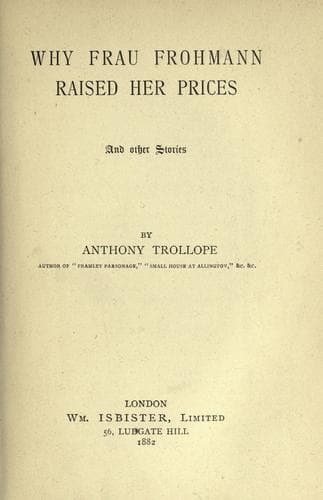
Why Frau Frohmann Raised Her Prices, and Other StoriesTrollope, Anthony
General
Why Frau Frohmann Raised Her Prices, and Other Stories
Trollope, Anthony
English fiction -- 19th century; Manners and customs -- Fiction; Short stories, English
There was ever so much in this which annoyed Alice. In the first place,
the word “pop” was to her abominable. Then she was almost called upon to
deny that he would “pop,” when in her heart she thought it very
probable that he might. And the word, she knew, had become intelligible
to the eldest of her little sisters who was present. Moreover, she was
most unwilling to discuss the subject at all, and could hardly leave it
undiscussed when such direct questions were asked. “Mamma,” she said,
“don’t let us think about anything of the kind.” This did not at all
satisfy herself. She ought to have repudiated the lover altogether; and
yet she could not bring herself to tell the necessary lie.
“I suppose he will come--some day,” said Minnie, the child old enough to
understand the meaning of such coming.
“For men may come and men may go,
But I go on for ever,--for ever,”
said or sang Alice, with a pretence of drollery, as she turned herself
to her little sister. But even in her little song there was a purpose.
Let any man come or let any man go, she would go on, at any rate
apparently untroubled, in her walk of life.
“Of course he’ll take you away, and then what am I to do?” said Mrs.
Dugdale moaning. It is sad enough for a girl thus to have her lover
thrown in her face when she is by no means sure of her lover.
A day or two afterwards another word, much more painful, was said to her
up at the parsonage. Into the parsonage she went frequently to show that
there was nothing in her heart to prevent her visiting her old friends
as had been her wont.
“John will be down here next week,” said the parson, whom she met on
the gravel drive just at the hall door.
“How often he comes! What do they do at the Horse Guards, or wherever it
is that he goes to?”
“He’ll be more steady when he has taken a wife,” said the old man.
“In the meantime what becomes of the cavalry?”
“I dare say you’ll know all about that before long,” said the parson
laughing.
“Now, my dear, how can you be so foolish as to fill the girl’s head with
nonsense of that kind?” said Mrs. Rossiter, who at that moment came out
from the front door. “And you’re doing John an injustice. You are making
people believe that he has said that which he has not said.”
Alice at the moment was very angry,--as angry as she well could be. It
was certain that Mrs. Rossiter did not know what her son had said or had
not said. But it was cruel that she who had put forward no claim, who
had never been forward in seeking her lover, should be thus almost
publicly rebuked. Quiet as she wished to be, it was necessary that she
should say one word in her own defence. “I don’t think Mr. Rossiter’s
little joke will do John any injustice or me any harm,” she said. “But,
as it may be taken seriously, I hope he will not repeat it.”
Public-domain text, read in full here on John Shaqi.
Reviews
Reviews
No reviews yet
Be the first to share your thoughts on this work.
Elsewhere in the archive
Join the Discussion
Join the discussion
Sign in to leave a comment or review.
Sign InorCreate an account