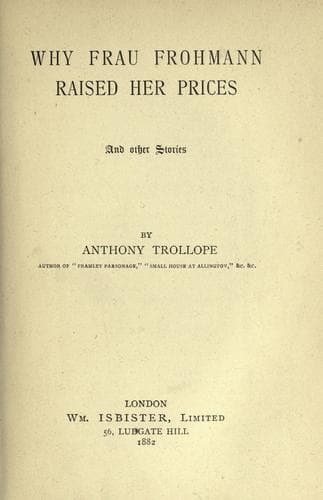
Why Frau Frohmann Raised Her Prices, and Other StoriesTrollope, Anthony
General
Why Frau Frohmann Raised Her Prices, and Other Stories
Trollope, Anthony
English fiction -- 19th century; Manners and customs -- Fiction; Short stories, English
“He could not do better for himself. That’s my opinion,” said the old
man, turning back into the house. There had been words before on the
subject between him and his wife, and he was not well pleased with her
at this moment.
“My dear Alice, I am sure you know that I mean everything the best for
you,” said Mrs. Rossiter.
“If nobody would mean anything, but just let me alone, that would be
best. And as for nonsense, Mrs. Rossiter, don’t you know of me that I’m
not likely to be carried away by foolish ideas of that kind?”
“I do know that you are very good.”
“Then why should you talk at me as though I were very bad?” Mrs.
Rossiter felt that she had been reprimanded, and was less inclined than
ever to accept Alice as a daughter-in-law.
Alice, as she walked home, was low in spirits, and angry with herself
because it was so. People would be fools. Of course that was to be
expected. She had known all along that Mrs. Rossiter wanted a grander
wife for her son, whereas the parson was anxious to have her for his
daughter-in-law. Of course she loved the parson better than his wife.
But why was it that she felt at this moment that Mrs. Rossiter would
prevail?
“Of course it will be so,” she said to herself. “I see it now. And I
suppose he is right. But then certainly he ought not to have come here.
But perhaps he comes because he wishes to--see Miss Wanless.” She went a
little out of her road home, not only to dry a tear, but to rid herself
of the effect of it, and then spent the remainder of the afternoon
swinging her brothers and sisters in the garden.
CHAPTER II.
MAJOR ROSSITER.
“Perhaps he is coming here to see Miss Wanless,” Alice had said to
herself. And in the course of that week she found that her surmise was
correct. John Rossiter stayed only one night at the parsonage, and then
went over to Brook Park where lived Sir Walter Wanless and all the
Wanlesses. The parson had not so declared when he told Alice that his
son was coming, but John himself said on his arrival that this was a
special visit made to Brook Park, and not to Beetham. It had been
promised for the last three months, though only fixed lately. He took
the trouble to come across to the doctor’s house with the express
purpose of explaining the fact. “I suppose you have always been intimate
with them,” said Mrs. Dugdale, who was sitting with Alice and a little
crowd of the children round them. There was a tone of sarcasm in the
words not at all hidden. “We all know that you are a great deal finer
than we mere village folk. We don’t know the Wanlesses, but of course
you do. You’ll find yourself much more at home at Brook Park than you
can in such a place as this.” All that, though not spoken, was contained
in the tone of the lady’s speech.
“We have always been neighbours,” said John Rossiter.
“Neighbours ten miles off!” said Mrs Dugdale.
“I dare say the Good Samaritan lived thirty miles off,” said Alice.
“I don’t think distance has much to do with it,” said the Major.
Public-domain text, read in full here on John Shaqi.
Reviews
Reviews
No reviews yet
Be the first to share your thoughts on this work.
Elsewhere in the archive
Join the Discussion
Join the discussion
Sign in to leave a comment or review.
Sign InorCreate an account