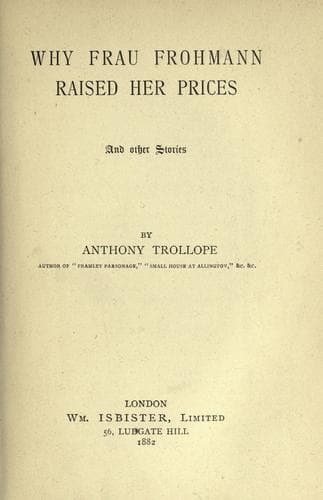
Why Frau Frohmann Raised Her Prices, and Other StoriesTrollope, Anthony
General
Why Frau Frohmann Raised Her Prices, and Other Stories
Trollope, Anthony
English fiction -- 19th century; Manners and customs -- Fiction; Short stories, English
IV. MR. BROWN THE HAIRDRESSER 298
V. ABRAHAM HALL MARRIED 310
ALICE DUGDALE.
I. THE DOCTOR’S FAMILY 323
II. MAJOR ROSSITER 333
III. LADY WANLESS 342
IV. THE BEETHAMITES 352
V. THE INVITATION 362
VI. THE ARCHERY MEETING 371
VII. AFTER THE PARTY 381
VIII. SIR WALTER UP IN LONDON 391
IX. LADY DEEPBELL 400
X. THE BIRD THAT PECKED AT THE WINDOW 409
WHY FRAU FROHMANN RAISED
HER PRICES.
CHAPTER I.
THE BRUNNENTHAL PEACOCK.
If ever there was a Tory upon earth, the Frau Frohmann was a Tory; for I
hold that landed possessions, gentle blood, a gray-haired butler behind
one’s chair, and adherence to the Church of England, are not necessarily
the distinguishing marks of Toryism. The Frau Frohmann was a woman who
loved power, but who loved to use it for the benefit of those around
her,--or at any rate to think that she so used it. She believed in the
principles of despotism and paternal government,--but always on the
understanding that she was to be the despot. In her heart of hearts she
disliked education, thinking that it unfitted the minds of her humbler
brethren for the duties of their lives. She hated, indeed, all
changes,--changes in costume, changes in hours, changes in cookery, and
changes in furniture; but of all changes she perhaps hated changes in
prices the most. Gradually there had come over her a melancholy
conviction that the world cannot go on altogether unaltered. There was,
she felt, a fate in things,--a necessity which, in some dark way within
her own mind, she connected with the fall of Adam and the general
imperfection of humanity,--which demanded changes, but they were always
changes for the worse; and therefore, though to those around her she was
mostly silent on this matter, she was afflicted by a general idea that
the world was going on towards ruin. That all things throve with herself
was not sufficient for her comfort; for, being a good woman with a large
heart, she was anxious for the welfare not only of herself and of her
children, but for that of all who might come after her, at any rate in
her own locality. Thus, when she found that there was a tendency to dine
at one instead of twelve, to wear the same clothes on week days as on
Sundays, to desire easy chairs, and linen that should be bleached
absolutely white, thoughts as to the failing condition of the world
would get the better of her and make her melancholy.
Public-domain text, read in full here on John Shaqi.
Reviews
Reviews
No reviews yet
Be the first to share your thoughts on this work.
Join the Discussion
Join the discussion
Sign in to leave a comment or review.
Sign InorCreate an account