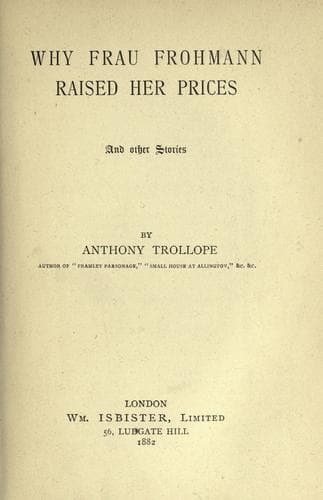
Why Frau Frohmann Raised Her Prices, and Other Stories — John Shaqi
Why Frau Frohmann Raised Her Prices, and Other StoriesTrollope, Anthony
General
Why Frau Frohmann Raised Her Prices, and Other Stories
Trollope, Anthony
English fiction -- 19th century; Manners and customs -- Fiction; Short stories, English
That had taken place on the Sunday, and it was on the following day that
the two lovers were in the arbour together. Now it must be understood
that all the world knew that these lovers were lovers, and that all the
world presumed that they were to become husband and wife. There was not
and never had been the least secrecy about it. Malchen was four or five
and twenty, and he was perhaps thirty. They knew their own minds, and
were, neither of them, likely to be persuaded by others either to marry
or not to marry. The Frau had given her consent,--not with that ecstacy
of joy with which sons-in-law are sometimes welcomed,--but still
without reserve. The kaplan had given in his adhesion. The young lawyer
was not quite the man he liked,--entertained some of the new ideas about
religion, and was given to innovations; but he was respectable and
well-to-do. He was a lover against whom he, as a friend of the family,
could not lift up his voice. Peter did not like the man, and Peter, in
his way, was fond of his sister. But he had not objected. Had he done
so, it would not have mattered much. Malchen was stronger at the
Brunnenthal than Peter. Thus it may be said that things generally smiled
upon the lovers. But yet no one had ever heard that a day was fixed for
their marriage. Madame Weiss had once asked Malchen, and Malchen had
told her--not exactly to mind her own business; but that had been very
nearly the meaning of what she had said.
There was, indeed, a difficulty; and this was the difficulty. The Frau
had assented--in a gradual fashion, rather by not dissenting as the
thing had gone on, so that it had come to be understood that the thing
was to be. But she had never said a word as to the young lady’s
fortune--as to that “mitgift” which in such a case would certainly be
necessary. Such a woman as the Frau in giving her daughter would surely
have to give something with her. But the Frau was a woman who did not
like parting with her money; and was such a woman that even the lawyer
did not like asking the question. The fraulein had once inquired, but
the mother had merely raised her eyebrows and remained silent. Then the
lawyer had told the priest that in the performance of her moral duties
the Frau ought to settle something in her own mind. The priest had
assented, but had seemed to imply that in the performance of such a duty
an old lady ought not to be hurried. A year or two, he seemed to think,
would not be too much for consideration. And so the matter stood at the
present moment.
Public-domain text, read in full here on John Shaqi.
Reviews
Reviews
No reviews yet
Be the first to share your thoughts on this work.
Join the Discussion
Join the discussion
Sign in to leave a comment or review.
Sign InorCreate an account