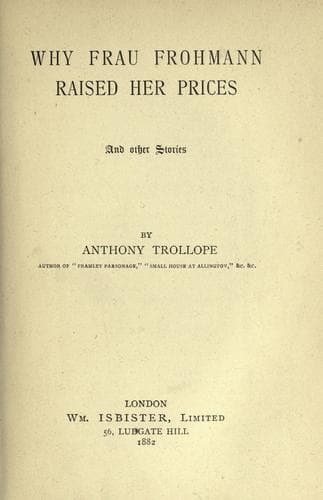
Why Frau Frohmann Raised Her Prices, and Other StoriesTrollope, Anthony
General
Why Frau Frohmann Raised Her Prices, and Other Stories
Trollope, Anthony
English fiction -- 19th century; Manners and customs -- Fiction; Short stories, English
“He’ll be sure to come back,” said Mrs Dugdale to her husband.
“We shall do no good by talking about it,” said the doctor. “If you will
take my advice, you will not mention his name to her. I fear that he is
worthless and unworthy of mention.” That might be very well, thought
Mrs. Dugdale; but no one in the village doubted that he had at the very
least £1,500 a year, and that he was a handsome man, and such a one as
is not to be picked up under every hedge. The very men who go about the
world most like butterflies before marriage “steady down the best”
afterwards. These were her words as she discussed the matter with Mrs.
Tweed, and they both agreed that if the hero showed himself again at the
doctor’s house “bygones ought to be bygones.”
Lady Wanless, even after her husband’s return from London, declared to
herself that even yet the game had not been altogether played out. Sir
Walter, who had been her only possible direct messenger to the man
himself, had been, she was aware, as bad a messenger as could have been
selected. He could be neither authoritative nor persuasive. Therefore
when he told her, on coming home, that it was easy to perceive that
Major Rossiter’s father could not have been educated at Christchurch,
she did not feel very much disappointed. As her next step she determined
to call on Mrs. Rossiter. If that should fail she must beard the lion in
his den, and go herself to Major Rossiter at the Horse Guards. She did
not doubt but that she would at least be able to say more than Sir
Walter. Mrs. Rossiter, she was aware, was herself favourable to the
match.
“My dear Mrs. Rossiter,” she said in her most confidential manner,
“there is a little something wrong among these young people, which I
think you and I can put right if we put our heads together.”
“If I know one of the young people,” said Mrs. Rossiter, “it will be
very hard to make him change his mind.”
“He has been very attentive to the young lady.”
“Of course I know nothing about it, Lady Wanless. I never saw them
together.”
“Dear Georgiana is so very quiet that she said nothing even to me, but I
really thought that he had proposed to her. She won’t say a word against
him, but I believe he did. Now, Mrs. Rossiter, what has been the meaning
of it?”
“How is a mother to answer for her son, Lady Wanless?”
“No;--of course not. I know that. Girls, of course, are different. But I
thought that perhaps you might know something about it, for I did
imagine you would like the connection.”
“So I should. Why not? Nobody thinks more of birth than I do, and
nothing in my opinion could have been nicer for John. But he does not
see with my eyes. If I were to talk to him for a week it would have no
effect.”
“Is it that girl of the doctor’s, Mrs. Rossiter?”
“I think not. My idea is that when he has turned it all over in his mind
he has come to the conclusion that he will be better without a wife than
with one.”
Public-domain text, read in full here on John Shaqi.
Reviews
Reviews
No reviews yet
Be the first to share your thoughts on this work.
Elsewhere in the archive
Join the Discussion
Join the discussion
Sign in to leave a comment or review.
Sign InorCreate an account