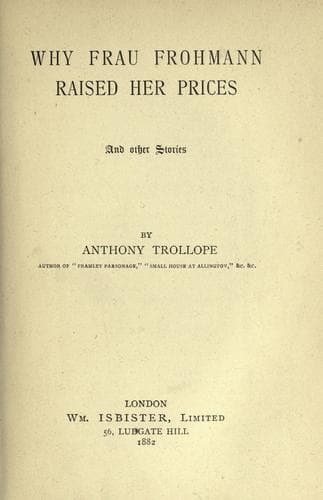
Why Frau Frohmann Raised Her Prices, and Other StoriesTrollope, Anthony
General
Why Frau Frohmann Raised Her Prices, and Other Stories
Trollope, Anthony
English fiction -- 19th century; Manners and customs -- Fiction; Short stories, English
“We might cure him of that, Mrs. Rossiter. If I could only have him down
there at Brook Park for another week, I am sure he would come to.” Mrs.
Rossiter, however, could not say that she thought it probable that her
son would be induced soon to pay another visit to Brook Park.
A week after this Lady Wanless absolutely did find her way into the
Major’s presence at the Horse Guards,--but without much success. The
last words at that interview only shall be given to the reader,--the
last words as they were spoken both by the lady and by the gentleman.
“Then I am to see my girl die of a broken heart?” said Lady Wanless,
with her handkerchief up to her eyes.
“I hope not, Lady Wanless; but in whatever way she might die, the fault
would not be mine.” There was a frown on the gentleman’s brow as he said
this which cowed even the lady.
As she went back to Slowbridge that afternoon, and then home to Brook
Park, she determined at last that the game must be looked upon as played
out. There was no longer any ground on which to stand and fight. Before
she went to bed that night she sent for Georgiana. “My darling child,”
she said, “that man is unworthy of you.”
“I always thought he was,” said Georgiana. And so there was an end to
that little episode in the family of the Wanlesses.
CHAPTER X.
THE BIRD THAT PECKED AT THE WINDOW.
THE bird that had flown in at the window and had been made welcome, had
flown away ungratefully. Let him come again pecking as he might at the
window, no more crumbs of love should be thrown to him. Alice, with a
steady purpose, had resolved on that. With all her humble ways, her
continual darning of stockings, her cutting of bread and butter for the
children, her pushing of the perambulator in the lanes, there was a
pride about her, a knowledge of her own dignity as a woman, which could
have been stronger in the bosom of no woman of title, of wealth, or of
fashion. She claimed nothing. She had expected no admiration. She had
been contented to take the world as it came to her, without thinking
much of love or romance. When John Rossiter had first shown himself at
Beetham, after his return from India, and when he had welcomed her so
warmly,--too warmly,--as his old playfellow, no idea had occurred to her
that he would ever be more to her than her old playfellow. Her own heart
was too precious to herself to be given away idly to the first comer.
Then the bird had flown in at the window, and it had been that the
coming of the stranger had been very sweet to her. But, even for the
stranger, she would not change her ways,--unless, perchance, some day
she might appertain to the stranger. Then it would be her duty to fit
herself entirely to him. In the meantime, when he gave her little hints
that something of her domestic slavery might be discontinued, she would
not abate a jot from her duties. If he liked to come with her when she
pushed the children, let him come. If he cared to see her when she was
Public-domain text, read in full here on John Shaqi.
Reviews
Reviews
No reviews yet
Be the first to share your thoughts on this work.
Elsewhere in the archive
Join the Discussion
Join the discussion
Sign in to leave a comment or review.
Sign InorCreate an account