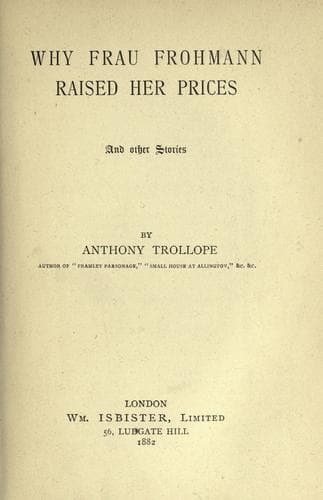
Why Frau Frohmann Raised Her Prices, and Other StoriesTrollope, Anthony
General
Why Frau Frohmann Raised Her Prices, and Other Stories
Trollope, Anthony
English fiction -- 19th century; Manners and customs -- Fiction; Short stories, English
Two or three weeks went by in the Brunnenthal without any special
occurrence, and Malchen had not as yet spoken to her mother about her
fortune. The Frau had during this time been in more than ordinary good
humour with her own household. July had opened with lovely weather, and
the house had become full earlier than usual. The Frau liked to have the
house full, even though there might be no profit, and therefore she was
in a good humour. But she had been exceptionally busy, and was trying
experiments in her housekeeping, as to which she was still in hope that
they would carry her through all her difficulties. She had been both to
Brixen on one side of the mountain and to Innsbruck on the other, and
had changed her butcher. Her old friend Hoff, at the latter place, had
altogether declined to make any reduction in his prices. Of course they
had been raised within the last five or six years. Who did not know that
that had been the case with butchers’ meat all the world over? As it
was, he charged the Frau less than he charged the people at the Golden
Lion. So at least he swore; and when she told him that unless an
alteration was made she must take her custom elsewhere--he bade her go
elsewhere. Therefore she did make a contract with the butcher at Brixen
on lower terms, and seemed to think that she had got over her
difficulty. But Brixen was further than Innsbruck, and the carriage was
more costly. It was whispered also about the house that the meat was not
equally good. Nobody, however, had as yet dared to say a word on that
subject to the Frau. And she, though in the midst of her new efforts she
was good-humoured herself,--as is the case with many people while they
have faith in the efforts they are making,--had become the cause of much
unhappiness among others. Butter, eggs, poultry, honey, fruit, and
vegetables, she was in the habit of buying from her neighbours, and had
been so excellent a customer that she was as good as a market to the
valley in general. There had usually been some haggling; but that, I
think, by such vendors is considered a necessary and almost an agreeable
part of the operation. The produce had been bought and sold, and the
Frau had, upon the whole, been regarded as a kind of providence to the
Brunnenthal. But now there were sad tales told at many a cottage and
small farmstead around. The Frau had declared that she would give no
more than three zwansigers a pair for chickens, and had insisted on
having both butter and eggs at a lower price than she had paid last
year. And she had succeeded, after infinite clamours. She had been their
one market, their providence, and they had no other immediate customers
to whom to betake themselves. The eggs and the butter, the raspberries
and the currants, must be sold. She had been imperious and had
succeeded, for a while. But there were deep murmurs, and already a
feeling was growing up in favour of Innsbruck and a market cart. It was
very dreadful.
Public-domain text, read in full here on John Shaqi.
Reviews
Reviews
No reviews yet
Be the first to share your thoughts on this work.
Join the Discussion
Join the discussion
Sign in to leave a comment or review.
Sign InorCreate an account