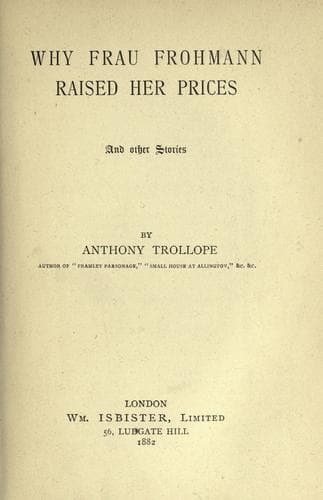
Why Frau Frohmann Raised Her Prices, and Other StoriesTrollope, Anthony
General
Why Frau Frohmann Raised Her Prices, and Other Stories
Trollope, Anthony
English fiction -- 19th century; Manners and customs -- Fiction; Short stories, English
But the Frau, resolute in her attempt, and proud of her success as far
as it had gone, constantly adducing the conduct of these two rival
butchers as evidence of her own wisdom, kept her ground like a Trojan.
All the old courses were served, and the puddings and the fruit were at
first as copious as ever. If the meat was inferior in quality,--and it
could not be so without her knowledge, for she had not reigned so long
in the kitchen of the Peacock without having become a judge in such
matters,--she was willing to pass the fault over for a time. She tried
to think that there was not much difference. She almost tried to believe
that second-rate meat would do as well as first-rate. There should at
least be no lack of anything in the cookery. And so she toiled and
struggled, and was hopeful that she might have her own way and prove to
all her advisers that she knew how to manage the house better than any
of them.
There was great apparent good humour. Though she had frowned upon Peter
when he had shown a disposition to spoil those Egyptians the
Cartwrights, she had only done so in defence of her own resolute
purpose, and soon returned to her kind looks. She was, too, very civil
to Malchen, omitting for the time her usual gibes and jeers as to her
daughter’s taste for French finery and general rejection of Tyrolese
customs. And she said nothing of the prolonged absence of her two
counsellors, the priest and the lawyer. A great struggle was going on
within her own bosom, as to which she in these days said not a word to
anybody. One counsellor had told her to raise her prices; another had
advised her to lessen the luxuries supplied. As both the one proposition
and the other had gone against her spirit, she had looked about her to
find some third way out of her embarrassments. She had found it, and the
way was one which recommended itself to her own sense of abstract
justice. The old prices should prevail in the valley everywhere. She
would extort nothing from Mr. Cartwright, but then neither should her
neighbours extort anything from her. Seppel’s wife was ill, and she had
told him that in consequence of that misfortune the increased wages
should be continued for three months, but that after that she must
return to the old rate. In the softness of her heart she would have
preferred to say six months, but that in doing so she would have seemed
to herself to have departed from the necessary rigour of her new
doctrine. But when Seppel stood before her, scratching his head, a
picture of wretchedness and doubt, she was not comfortable in her mind.
Seppel had a dim idea of his own rights, and did not like to be told
that his extra zwansigers came to him from the Frau’s charity. To go
away from the Brunnenthal at the end of the summer, to go away at all,
would be terrible to him; but to work for less than fair wages, would
that not be more terrible? Of all which the Frau, as she looked at him,
understood much.
Public-domain text, read in full here on John Shaqi.
Reviews
Reviews
No reviews yet
Be the first to share your thoughts on this work.
Join the Discussion
Join the discussion
Sign in to leave a comment or review.
Sign InorCreate an account