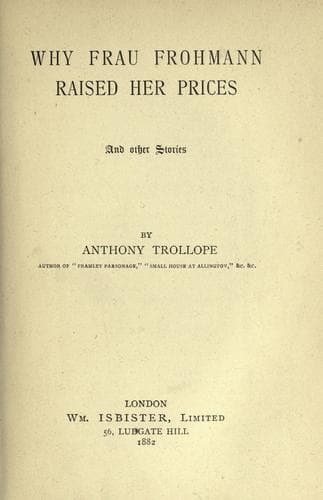
Why Frau Frohmann Raised Her Prices, and Other StoriesTrollope, Anthony
General
Why Frau Frohmann Raised Her Prices, and Other Stories
Trollope, Anthony
English fiction -- 19th century; Manners and customs -- Fiction; Short stories, English
After sundry inquiries on each side, respecting the children and the
guests, and the state of things in the world at large, the real question
was asked, “Ah, meine liebe Frau Frohmann,--my very dear Mrs. Frohmann,
as one might say here,--why are you dealing with us all in the
Brunnenthal after this hard fashion?”
“What do you call a hard fashion, Suse?”
“Only giving half price for everything that you buy. Why should anything
be cheaper this year than it was last? Ah, alas! does not everybody know
that everything is dearer?”
“Why should anything be dearer, Suse? The people who come here are not
charged more than they were twenty years ago.”
“Who can tell? How can an old woman say? It is all very bad. The world,
I suppose, is getting worse. But it is so. Look at the taxes.”
The taxes, whether imperial or municipal, was a matter on which Frau did
not want to speak. She felt that they were altogether beyond her reach.
No doubt there had been a very great increase in such demands during her
time, and it was an increase against which nobody could make any stand
at all. But, if that was all, there had been a rise in prices quite
sufficient to answer that. She was willing to pay three zwansigers a
pair for chickens, and yet she could remember when they were to be
bought for a zwansiger each.
“Yes, taxes,” she said; “they are an evil which we must all endure. It
is no good grumbling at them. But we have had the roads made for us.”
This was an unfortunate admission, for it immediately gave Suse Krapp an
easy way to her great argument. “Roads, yes! and they are all saying
that they must make use of them to send the things into market.
Josephine Bull took her eggs into the city and got two kreutzers apiece
for them.”
The Frau had already heard of that journey, and had also heard that poor
Josephine Bull had been very much fatigued by her labours. It had
afflicted her much, both that the poor woman should have been driven to
such a task, and that such an innovation should have been attempted. She
had never loved Innsbruck dearly, and now she was beginning to hate the
place. “What good did she get by that, Suse? None, I fear. She had
better have given her eggs away in the valley.”
“But they will have a cart.”
“Do you think a cart won’t cost money? There must be somebody to drive
the cart, I suppose.” On this point the Frau spoke feelingly, as she was
beginning to appreciate the inconvenience of sending twice a week all
the way to Brixen for her meat. There was a diligence, but though the
horses were kept in her own stables, she had not as yet been able to
come to terms with the proprietor.
“There is all that to think of certainly,” said Suse. “But----. Wouldn’t
you come back, meine liebe Frau, to the prices you were paying last
year? Do you not know that they would sooner sell to you than to any
other human being in all the world, and they must live by their little
earnings?”
Public-domain text, read in full here on John Shaqi.
Reviews
Reviews
No reviews yet
Be the first to share your thoughts on this work.
Join the Discussion
Join the discussion
Sign in to leave a comment or review.
Sign InorCreate an account