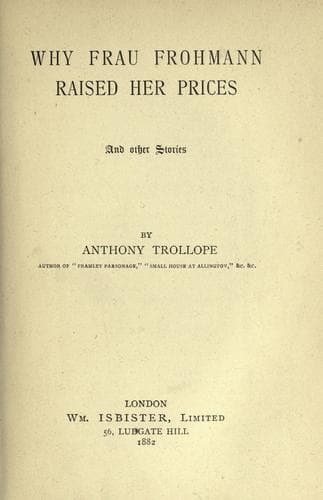
Why Frau Frohmann Raised Her Prices, and Other StoriesTrollope, Anthony
General
Why Frau Frohmann Raised Her Prices, and Other Stories
Trollope, Anthony
English fiction -- 19th century; Manners and customs -- Fiction; Short stories, English
When a man is asked by his friend if he knows of a horse to be sold he
does not like immediately to suggest a transfer of the animal which he
has in his own stable, though he may at the moment be in want of money
and anxious to sell his steed. So it was with Mr. Gregory. His sister
would be delighted to take as a boarder a young lady for whom liberal
payment would be made; but at the first moment he had hesitated to make
an offer by which his own sister would be benefited. On the next
morning, however, he wrote as follows:--
“DEAR MRS. MILES,--My sister Amelia is living at Avranches, where
she has a pleasant little house on the outskirts of the town, with
a garden. An old friend was living with her, but she died last
year, and my sister is now alone. If you think that Bessy would
like to sojourn for awhile in Normandy, I will write to Amelia and
make the proposition. Bessy will find my sister good-tempered and
kind-hearted.--Faithfully yours, JOSHUA GREGORY.”
Mrs. Miles did not care much for the good temper and the kind heart. Had
she asked herself whether she wished Bessy to be happy she would no
doubt have answered herself in the affirmative. She would probably have
done so in regard to any human being or animal in the world. Of course,
she wanted them all to be happy. But happiness was to her thinking of
much less importance than duty; and at the present moment her duty and
Bessy’s duty and Philip’s duty were so momentous that no idea of
happiness ought to be considered in the matter at all. Had Mr. Gregory
written to say that his sister was a woman of severe morals, of stern
aspect, prone to repress all youthful ebullitions, and supposed to be
disagreeable because of her temper, all that would have been no
obstacle. In the present condition of things suffering would be better
than happiness; more in accord with the feelings and position of the
person concerned. It was quite intelligible to Mrs. Miles that Bessy
should really love Philip almost to the breaking of her heart, quite
intelligible that Philip should have set his mind upon the untoward
marriage with all the obstinacy of a proud man. When young men and young
women neglect their duty, hearts have to be broken. But it is not a soft
and silken operation, which can be made pleasant by good temper and
social kindness. It was necessary, for certain quite adequate reasons,
that Bessy should be put on the wheel, and be racked and tormented. To
talk to her of the good temper of the old woman who would have to turn
the wheel would be to lie to her. Mrs. Miles did not want her to think
that things could be made pleasant for her.
Public-domain text, read in full here on John Shaqi.
Reviews
Reviews
No reviews yet
Be the first to share your thoughts on this work.
Elsewhere in the archive
Join the Discussion
Join the discussion
Sign in to leave a comment or review.
Sign InorCreate an account