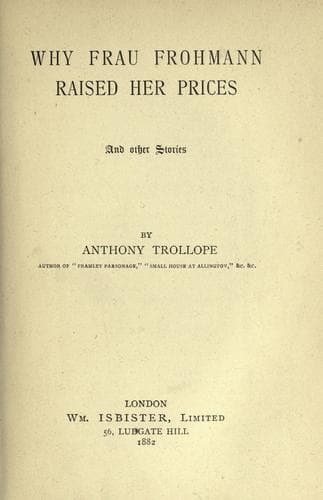
Why Frau Frohmann Raised Her Prices, and Other StoriesTrollope, Anthony
General
Why Frau Frohmann Raised Her Prices, and Other Stories
Trollope, Anthony
English fiction -- 19th century; Manners and customs -- Fiction; Short stories, English
Soon after the receipt of Mr. Gregory’s letter she sent for Bessy, who
was then brought into the room under the guard, as it were, of Mrs.
Knowl. Mrs. Knowl accompanied her along the corridor, which was surely
unnecessary, as Bessy’s door had not been locked upon her. Her
imprisonment had only come from obedience. But Mrs. Knowl felt that a
great trust had been confided to her, and was anxious to omit none of
her duties. She opened the door so that the invalid on the bed could see
that this duty had been done, and then Bessy crept into the room. She
crept in, but very quickly, and in a moment had her arms round the old
woman’s back and her lips pressed to the old woman’s forehead. “Why may
not I come and be with you?” she said.
“Because you are disobedient.”
“No, no; I do all that you tell me. I have not stirred from my room,
though it was hard to think you were ill so near me, and that I could do
nothing. I did not try to say a word to him, or even to look at him; and
now that he has gone, why should I not be with you?”
“It cannot be.”
“But why not, aunt? Even though you would not speak to me I could be
with you. Who is there to read to you?”
“There is no one. Of course it is dreary. But there are worse things
than dreariness.”
“Why should not I come back, now that he has gone?” She still had her
arm round the old woman’s back, and had now succeeded in dragging
herself on to the bed and in crouching down by her aunt’s side. It was
her perseverance in this fashion that had so often forced Mrs. Miles out
of her own ordained method of life, and compelled her to leave for a
moment the strictness which was congenial to her. It was this that had
made her declare to Mr. Gregory, in the midst of her severity, that
Bessy had been like a gleam of sunshine in the house. Even now she knew
not how to escape from the softness of an embrace which was in truth so
grateful to her. It was a consciousness of this,--of the potency of
Bessy’s charm even over herself,--which had made her hasten to send her
away from her. Bessy would read to her all the day, would hold her hand
when she was half dozing, would assist in every movement with all the
patience and much more than the tenderness of a waiting-maid. There was
no voice so sweet, no hand so cool, no memory so mindful, no step so
soft as Bessy’s. And now Bessy was there, lying on her bed, caressing
her, more closely bound to her than had ever been any other being in the
world, and yet Bessy was an enemy from whom it was imperatively
necessary that she should be divided.
“Get down, Bessy,” she said; “go off from me.”
“No, no, no,” said Bessy, still clinging to her and kissing her.
“I have that to say to you which must be said calmly.”
“I am calm,--quite calm. I will do whatever you tell me; only pray,
pray, do not send me away from you.”
“You say that you will obey me.”
“I will; I have. I always have obeyed you.”
“Will you give up your love for Philip?”
Public-domain text, read in full here on John Shaqi.
Reviews
Reviews
No reviews yet
Be the first to share your thoughts on this work.
Elsewhere in the archive
Join the Discussion
Join the discussion
Sign in to leave a comment or review.
Sign InorCreate an account