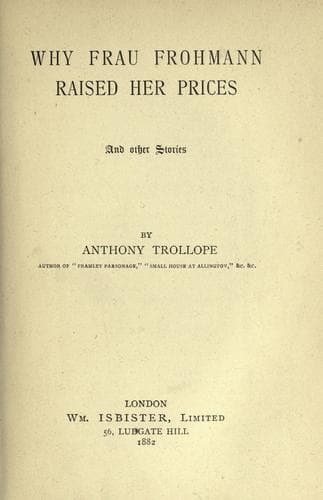
Why Frau Frohmann Raised Her Prices, and Other StoriesTrollope, Anthony
General
Why Frau Frohmann Raised Her Prices, and Other Stories
Trollope, Anthony
English fiction -- 19th century; Manners and customs -- Fiction; Short stories, English
When Bessy Pryor began to consider these two letters together, she felt
that the task was almost too much for her. Her lover’s letter had been
the first read. She had known his handwriting, and of course had read
his the first. And as she had read it everything seemed to be of rose
colour. Of course she had been filled with joy. Something had been done
by the warnings of Miss Gregory, something, but not much, to weaken her
strong faith in her lover. The major-general had been worldly and
untrue, and it had been possible that her Philip should be as had been
the major-general. There had been moments of doubt in which her heart
had fainted a little; but as she read her lover’s words she acknowledged
to herself how wrong she had been to faint at all. He declared it to be
“a matter in which his own future happiness was altogether bound up.”
And then there had been his playful allusion to her happiness, which was
not the less pleasant to her because he had pretended to think that the
“other person might be indifferent.” She pouted her lips at him, as
though he were present while she was reading, with a joyous affectation
of disdain. No, no; she could not consent to an immediate marriage at
Avranches. There must be some delay. But she would write to him and
explain all that. Then she read her aunt’s letter.
It moved her very much. She had read it all twice before there came upon
her a feeling of doubt, an acknowledgment to herself that she must
reconsider the matter. But even when she was only reading it, before she
had begun to consider, her former joy was repressed and almost quenched.
So much of it was too true, terribly true. Of course her duty should be
paramount. If she could persuade herself that duty required her to
abandon Philip, she must abandon him, let the suffering to herself or to
others be what it might. But then, what was it that duty required of
her? “To sacrifice herself is the special heroism which a woman can
achieve.” Yes, she believed that. But then, how about sacrificing
Philip, who, no doubt, was telling the truth when he said that his own
happiness was altogether bound up in his love?
She was moved too by all that which Mrs. Miles said as to the grandeur
of the Launay family. She had learned enough of the manners of Launay to
be quite alive to the aristocratic idiosyncrasies of the old woman. She,
Bessy Pryor, was nobody. It would have been well that Philip Launay
should have founded his happiness on some girl of higher birth. But he
had not done so. King Cophetua’s marriage had been recognised by the
world at large. Philip was no more than King Cophetua, nor was she less
than the beggar-girl. Like to like in marriages was no doubt
expedient,--but not indispensable. And though she was not Philip’s
equal, yet she was a lady. She would not disgrace him at his table, or
among his friends. She was sure that she could be a comfort to him in
his work.
Public-domain text, read in full here on John Shaqi.
Reviews
Reviews
No reviews yet
Be the first to share your thoughts on this work.
Elsewhere in the archive
Join the Discussion
Join the discussion
Sign in to leave a comment or review.
Sign InorCreate an account