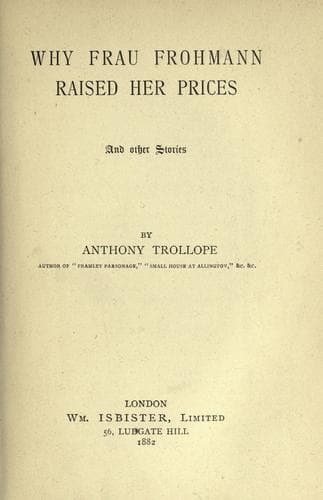
Why Frau Frohmann Raised Her Prices, and Other StoriesTrollope, Anthony
General
Why Frau Frohmann Raised Her Prices, and Other Stories
Trollope, Anthony
English fiction -- 19th century; Manners and customs -- Fiction; Short stories, English
But the parts of the old woman’s letter which moved her most were those
in which she gave full play to her own heart, and spoke, without
reserve, of her own love for her dearest Bessy. “My days are heavy to
bear because I have not my Bessy with me.” It was impossible to read
this and not to have some desire to yield. How good this lady had been
to her! Was it not through her that she had known Philip? But for Mrs.
Miles, what would her own life have been? She thought that had she been
sure of Philip’s happiness, could she have satisfied herself that he
would bear the blow, she would have done as she was asked. She would
have achieved her heroism, and shown the strength of her gratitude, and
would have taken her delight in administering to the comforts of her old
friend,--only that Philip had her promise. All that she could possibly
owe to all the world beside must be less, so infinitely less, than what
she owed to him.
She would have consulted Miss Gregory, but she knew so well what Miss
Gregory would have advised. Miss Gregory would only have mentioned the
major-general and her own experiences. Bessy determined, therefore, to
lie awake and think of it, and to take no other counsellor beyond her
own heart.
CHAPTER IX.
HOW BESSY PRYOR ANSWERED THE TWO LETTERS, AND WHAT CAME OF IT.
The letters were read very often, and that from Mrs. Miles I think the
oftener. Philip’s love was plainly expressed, and what more is expected
from a lover’s letter than a strong, manly expression of love? It was
quite satisfactory, declaring the one important fact that his happiness
was bound up in hers. But Mrs. Miles’ was the stronger letter, and by
far the more suggestive. She had so mingled hardness and softness, had
enveloped her stern lesson of feminine duty in so sweet a frame of
personal love, that it was hardly possible that such a girl as Bessy
Pryor should not be shaken by her arguments. There were moments during
the night in which she had almost resolved to yield. “A woman can soar
only by suffering.” She was not sure that she wanted to soar, but she
certainly did want to do her duty, even though suffering should come of
it. But there was one word in her aunt’s letter which militated against
the writer’s purpose rather than assisted it. “Since you first came to
me, you have never been false.” False! no; she hoped she had not been
false. Whatever might be the duty of a man or a woman, that duty should
be founded on truth. Was it not her special duty at this moment to be
true to Philip? I do not know that she was altogether logical. I do not
know but that in so supporting herself in her love there may have been a
bias of personal inclination. Bessy perhaps was a little prone to think
that her delight and her duty went together. But that flattering
assurance, that she had never yet been false, strengthened her
resolution to be true, now, to Philip.
Public-domain text, read in full here on John Shaqi.
Reviews
Reviews
No reviews yet
Be the first to share your thoughts on this work.
Elsewhere in the archive
Join the Discussion
Join the discussion
Sign in to leave a comment or review.
Sign InorCreate an account