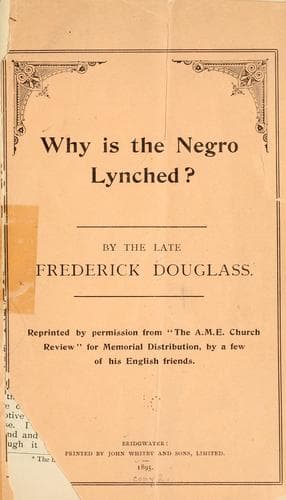
The point I make, then, is this. That I am not, in this case, dealing
with men in their natural condition. I am dealing with men brought up
in the exercise of irresponsible power. I am dealing with men whose
ideas, habits and customs are entirely different from those of ordinary
men. It is, therefore, quite gratuitous to assume that the principles
that apply to other men, apply to the lynchers and murderers of the
Negro. The rules resting upon the justice and benevolence of human
nature do not apply to the mobocrats, or to those who were educated in
the habits and customs of a slave-holding community. What these habits
are I have a right to know, both in theory and practice. Whoever has
read the laws of the late slave states relating to the Negroes, will
see what I mean.
I repeat, the mistake made by those who, on this ground, object to
my theory of the charge against the Negro, is that they overlook the
natural influence of the life, education and habits of the lynchers.
We must remember that these people have not now and have never had any
such respect for human life as is common to other men. They have had
among them for centuries a peculiar institution, and that peculiar
institution has stamped them as a peculiar people. They were not before
the war, they were not during the war, and have not been since the war,
in their spirit or in their civilization, a people in common with the
people of the North, or the civilized world. I will not here harrow up
your feelings by detailing their treatment of Northern prisoners during
the war. Their institutions have taught them no respect for human life,
and especially the life of the Negro. It has, in fact, taught them
absolute contempt for his life. The sacredness of life which ordinary
men feel does not touch them anywhere. A dead Negro is with them now,
as before, a common jest.
They care no more for the Negro’s rights to live than they care for
his rights to liberty, or his right to the ballot or any other right.
Chief Justice Taney told the exact truth about these people when he
said: “They did not consider that the black man had any rights which
white men were bound to respect.” No man of the South ever called in
question that statement, and no man ever will. They could always shoot,
stab, hang and burn the Negro, without any such remorse or shame as
other men would feel after committing such a crime. Any Southern man,
who is honest and is frank enough to talk on the subject, will tell you
that he has no such idea as we have of the sacredness of human rights,
and especially, as I have said, of the life of the Negro. Hence it is
absurd to meet my arguments with the facts predicated of our common
human nature.
Public-domain text, read in full here on John Shaqi.
Reviews
Reviews
No reviews yet
Be the first to share your thoughts on this work.
Join the Discussion
Join the discussion
Sign in to leave a comment or review.
Sign InorCreate an account