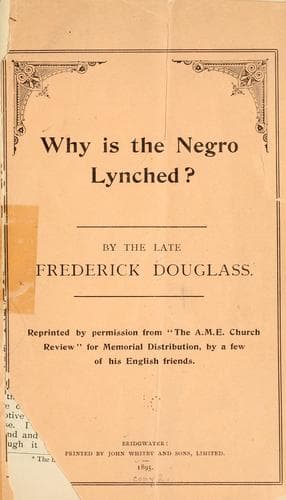
In an open letter addressed to me by ex-Governor Chamberlain, of South
Carolina, published in the Charleston _News and Courier_, in reply
to an article of mine on the subject of lynching, published in the
_North American Review_, the ex-Governor says: “Your denunciation of
the South on this point is directed exclusively, or nearly so, against
the application of lynch law for the punishment of one crime; the
existence, I suppose I might say the prevalence, of this crime at the
South is undeniable. But I read your article in vain for any special
denunciation of the crime itself. As you say, your people are lynched,
tortured and burned, for assault on white women. As you value your own
good fame and safety as a race, stamp out the infamous crime.”
And now comes the sweet voice of a Northern woman, Miss Frances
Willard, of the W. C. T. U., distinguished among her sisters for
benevolence and Christian charity. She speaks in the same bitter tone
and hurls against us the same blasting accusation. She says in a letter
now before me, “I pity the Southerners. The problem in their hands
is immeasurable. The coloured race multiplies like the locusts of
Egypt. The safety of women, of childhood, of the home, is menaced in a
thousand localities at this moment, so that men dare not go beyond the
sight of their own roof tree.” Such, then, is the crushing indictment
drawn up against the Southern Negroes, drawn up, too, by persons who
are perhaps the fairest and most humane of the Negro’s accusers. Yet
even they paint him as a moral monster, ferociously invading the sacred
rights of woman and endangering the homes of the whites.
INCRIMINATION OF THE WHOLE RACE.
Now, I hold, no less than his accusers, that the crime alleged against
the Negro is the most revolting which men can commit. It is a crime
that awakens the intensest abhorrence and tempts mankind to kill the
criminal on first sight.
But this charge thus brought against the Negro and as constantly
reiterated by his enemies, is plainly enough not merely a charge
against the individual culprit, as would be the case with an individual
of any other race, but it is in large measure a charge constructively
against the coloured people as such. It throws over every man of colour
a mantle of odium, and sets upon him a mark of popular hate, more
distressing than the mark set upon the first murderer. It points the
Negro out as an object of suspicion, avoidance and hate.
Public-domain text, read in full here on John Shaqi.
Reviews
Reviews
No reviews yet
Be the first to share your thoughts on this work.
Join the Discussion
Join the discussion
Sign in to leave a comment or review.
Sign InorCreate an account