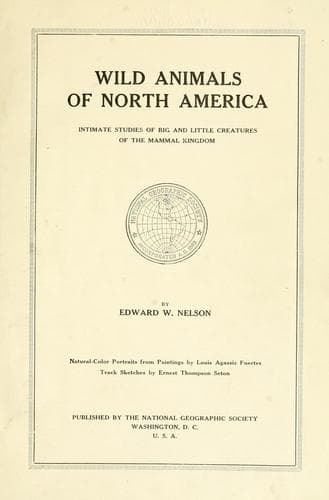
Wild Animals of North America: Intimate Studies of Big and Little Creatures of the Mammal KingdomNelson, Edward William
Science
Wild Animals of North America: Intimate Studies of Big and Little Creatures of the Mammal Kingdom
Nelson, Edward William
Mammals -- North America
This group is represented in limited areas on our southern border
by two species. One of these, the Gailliard jack rabbit (_Lepus
gailliardi_), occurs on the grassy plains of extreme southwestern New
Mexico and is succeeded by other white-sided species southward across
the Mexican tableland and through interior Oaxaca to the Pacific coast,
on the Isthmus of Tehuantepec. The other species, the antelope jack
rabbit, occupies a considerable area in southwestern Arizona, and with
its geographic races ranges southward through the coastal plains of
Sonora and Sinaloa to northern Tepic.
All jack rabbits are more or less closely related to the Old World
hares, the term “rabbit” having been so generally misapplied to them
by the early settlers in the western United States that the name is
now fixed by current usage. In Mexico and among the Mexicans of our
southwestern border the proper distinction is made and the jack rabbit
is termed _liebre_, or hare, and cottontail is called _conejo_, or
rabbit.
The white-sided species are more widely differentiated from their Old
World relatives than the other jack rabbits and are the southernmost
representatives of the true hares in America, reaching their limit in
the tropics a little beyond the Isthmus of Tehuantepec.
The extension of the white on the sides of these species assists
in producing one of the most extraordinary examples of directive
coloration known among mammals. I had the pleasure of discovering this
one day in May, 1895, when hunting on horseback over the grassy plain
bordering the Pacific coast of the Isthmus of Tehuantepec. As I rode
slowly along, a big jack rabbit hopped deliberately from its form in
the grass a few yards away, and by the contraction of a special set
of muscles along the back drew the dark-colored dorsal area forward
and together so that it formed only a narrow band on the middle of the
back, with a corresponding extension of the white area on the rump and
sides until, as the animal moved diagonally away, it looked almost
entirely white.
At a distance of fifty or sixty yards it came to a stop, and expanded
and contracted the dark dorsal area, thus producing a “flashing” effect
with the changing area of white on the sides and rump. This solved
the riddle of the mirror-like white flashes I had often seen as jack
rabbits on the tableland had dashed away in the brilliant sunshine.
The same habit of “flashing” the white was afterwards observed in
the species of southwestern New Mexico and southwestern Arizona,
demonstrating the appropriateness of the name, “antelope jack rabbit,”
given them by the ranchmen.
Public-domain text, read in full here on John Shaqi.
Reviews
Reviews
No reviews yet
Be the first to share your thoughts on this work.
Elsewhere in the archive
Join the Discussion
Join the discussion
Sign in to leave a comment or review.
Sign InorCreate an account