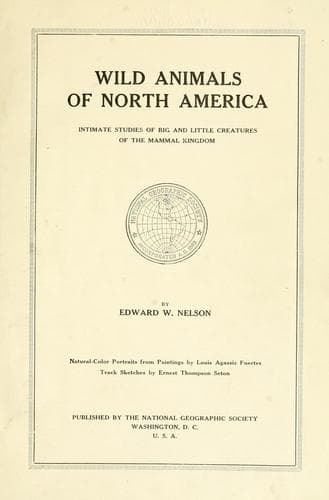
Wild Animals of North America: Intimate Studies of Big and Little Creatures of the Mammal KingdomNelson, Edward William
Science
Wild Animals of North America: Intimate Studies of Big and Little Creatures of the Mammal Kingdom
Nelson, Edward William
Mammals -- North America
Formerly the antelope jack rabbit of Arizona was common on the plains
about Tucson, where many were shot for rifle practice. They are now
comparatively scarce in that district, and are never so excessively
abundant as the common species of the West now and then becomes. They
have an extraordinary appearance as, with their great ears erect, they
stand poised on their long, thin legs. When alarmed, they leap away
with amazing celerity in long, high bounds. They are usually much more
shy and alert than the common jack rabbits and at times are far more
difficult to stalk than antelope. A peculiarly appropriate setting to
this remarkable species is found in the strange and wonderful growth of
giant cactuses, yuccas, creosote bushes, fouquerias, palo verde, and
other desert vegetation of the plains in Arizona and Sonora.
Like other hares, the antelope jack rabbits occupy forms under bushes
or in the shelter of little patches of coarse vegetation. The only
exception to this rule I have seen was west of the city of Guadalajara,
on the Mexican tableland. There one summer day, in the midst of a
lovely open valley covered with short, velvety green grass and dotted
with scattered acacia bushes, a caracara eagle suddenly swooped down
upon a young white-sided jack rabbit. In mortal terror the little beast
dashed away at great speed, the caracara casting at it repeatedly from
a height of fifteen or twenty feet and each time striking the ground
just behind. The young animal ran not less than five hundred yards,
straight for a little bush on a small bank, where it vanished as by
magic.
The caracara was close behind and, alighting, ran round and round the
trunk of the bush, craning its neck and apparently as surprised as
myself at this sudden disappearance. Riding over to investigate, I
found, partly concealed by coarse grass, the entrance of a burrow large
enough to admit an adult jack rabbit. It extended almost horizontally
into the bank for about eighteen inches, and then, turning abruptly to
the left, ended in a rounded chamber some fifteen inches in diameter,
in which the young jack rabbit lay snugly ensconced. It appeared
altogether probable that this burrow had been made by the old jack
rabbit as a shelter for her young, one of which in its extreme need had
again sought asylum there.
White-sided jack rabbits are frequently found in pairs, occupying
forms in close proximity to one another. More rarely several may be
found in a small area. When driven from the forms, they often run in a
wide circle, and in the course of half an hour or more may be detected
returning slyly and watchfully from a direction nearly opposite to that
in which they departed.
THE CALIFORNIA JACK RABBIT
(=Lepus californicus= and its subspecies)
(_For illustration, see page 507_)
Public-domain text, read in full here on John Shaqi.
Reviews
Reviews
No reviews yet
Be the first to share your thoughts on this work.
Elsewhere in the archive
Join the Discussion
Join the discussion
Sign in to leave a comment or review.
Sign InorCreate an account