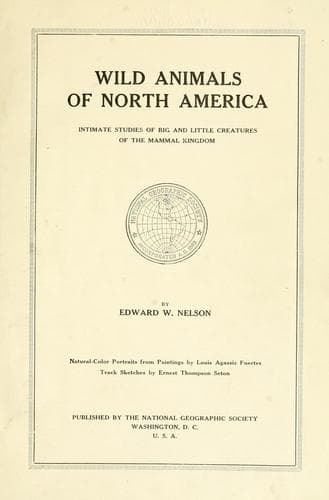
Wild Animals of North America: Intimate Studies of Big and Little Creatures of the Mammal KingdomNelson, Edward William
Science
Wild Animals of North America: Intimate Studies of Big and Little Creatures of the Mammal Kingdom
Nelson, Edward William
Mammals -- North America
In the region between the areas in which the summer coat remains
wholly white and where it is completely changed to grayish, there is a
gradual transition, with the lessening severity of the climate, through
every intermediate degree between the two. As in the case of the
snowshoe rabbit, the large hind feet and long spreading toes of its big
northern relative are so heavily covered with hair that they form broad
fluffy pads, which enable the hares to travel lightly over the arctic
snowfields.
The distribution of arctic hares is confined to the barrens or tundras
beyond the limit of trees. They range practically to the land’s
end of northern Greenland and Ellesmere Land. To the southward in
North America they range down the coast of Labrador and across to
Newfoundland, where they are limited to the open barrens. They also
occur along the shores of Hudson Bay and follow the tundras bordering
Bering Sea to the peninsula of Alaska.
In Ellesmere Land they are reported to be extraordinarily numerous
at times in certain little valleys, and the fur traders on the coast
south of the Yukon Delta informed me of similar gatherings in spring on
gently sloping hillsides in that region. Photographs taken in Ellesmere
Land show many of these hares scattered over a small area, each
crouched in a compact form and all heading in the same direction to
face the wind. Such gatherings, at least those in Alaska, occur during
the mating period, after which the animals scatter over the area they
occupy.
An account of the big northern hares would be incomplete without
reference to the white-tailed jack rabbit, the largest of all American
hares and a near relative of the arctic species. It attains a weight
of twelve pounds or more and appears like a giant of its kind. It has
longer legs than the arctic hare and a longer tail. In summer it is
grayish or buffy, with a conspicuous pure white tail. Throughout most
of its range in winter it becomes pure white except the black tips to
the ears, but near the southern border the change to white is not so
complete as in the North. The distribution of the white-tailed jack
rabbit extends from Minnesota to the Cascade Mountains and from the
Saskatchewan River, in Alberta, south to southern Colorado.
Arctic hares have from one to seven young in a litter each spring.
Owing to the climatic conditions under which they exist, it is doubtful
if more than a single litter is born each year.
Public-domain text, read in full here on John Shaqi.
Reviews
Reviews
No reviews yet
Be the first to share your thoughts on this work.
Elsewhere in the archive
Join the Discussion
Join the discussion
Sign in to leave a comment or review.
Sign InorCreate an account