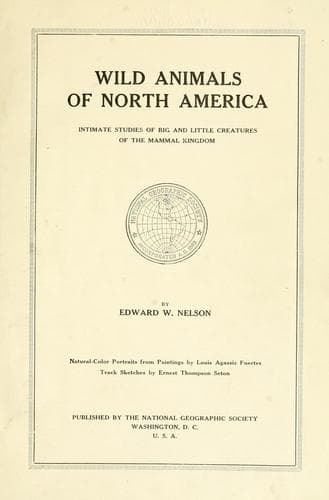
Wild Animals of North America: Intimate Studies of Big and Little Creatures of the Mammal KingdomNelson, Edward William
Science
Wild Animals of North America: Intimate Studies of Big and Little Creatures of the Mammal Kingdom
Nelson, Edward William
Mammals -- North America
Under favorable conditions they steadily increase until they become
enormously plentiful over great areas. After this swarming abundance
continues for several seasons it reaches a maximum, and then, as in the
case of many other mammals when similarly overabundant, a mysterious
malady suddenly attacks and sweeps them off, until within a year or two
they become rare over the entire area. The people of the fur country
believe these changes in numbers run in cycles of about seven years
each.
As the hares increase in numbers some of the birds and mammals which
prey upon them increase proportionately. This is specially marked
with the big northern lynxes. The skins of varying hares are gathered
and sent to the London fur market with other furs, including those of
lynxes. In the records of sales of the Hudson’s Bay Company there are
direct increases of the numbers of Canada lynx skins sold corresponding
with the increases in the sales of varying hare skins. As the number of
hare skins abruptly decreases following the outbreak of epidemics among
them, there are correspondingly abrupt decreases in the numbers of lynx
skins sold.
This correlation is shown in the records extending back many years and
illustrates the interdependence in nature between the various forms of
animal life. The far-reaching tragic effect of the sudden disappearance
of the snowshoe rabbits is not confined to the wild habitants of the
forest, as it has not infrequently brought starvation and death into
many lonely Indian lodges in the great northern wilderness.
=THE ARCTIC HARE= (=Lepus arcticus= and its relatives)
(_For illustration, see page 510_)
Many parts of the northernmost circumpolar lands are occupied by large
hares, which attain a weight of more than ten pounds. They are about
the size of large jack rabbits, but are more heavily proportioned, with
much shorter ears and shorter, stronger legs. There are several species
and geographic races of these animals, all of which are snowy white in
winter except for a small black tip on each ear. In summer the southern
arctic hares change to a nearly uniform dull iron gray or grayish
brown. The northernmost animals of Ellesmere Land and north Greenland,
where the summer is brief and severe arctic conditions prevail, retain
their white coat throughout the year.
In keeping with the cold climate of their territory, the furry coat
of the arctic hares is long and thick, especially in winter, when the
ears, legs, and even the soles of +he feet, as well as the body, are
heavily furred. The coats of the hares of north Greenland and adjacent
region are so heavy and fleecelike that during the spring molt they
come off in felted patches as the new coat is assumed, giving the hares
a curiously ragged appearance.
Public-domain text, read in full here on John Shaqi.
Reviews
Reviews
No reviews yet
Be the first to share your thoughts on this work.
Elsewhere in the archive
Join the Discussion
Join the discussion
Sign in to leave a comment or review.
Sign InorCreate an account