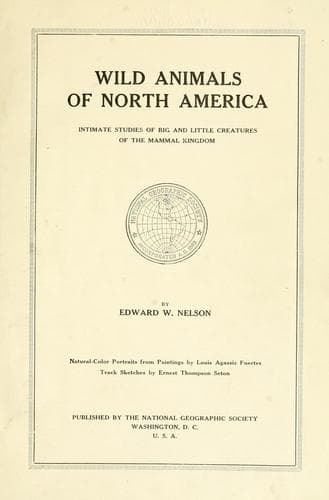
Wild Animals of North America: Intimate Studies of Big and Little Creatures of the Mammal KingdomNelson, Edward William
Science
Wild Animals of North America: Intimate Studies of Big and Little Creatures of the Mammal Kingdom
Nelson, Edward William
Mammals -- North America
The American mammals to which the term “rabbit” may be properly applied
include not only the cottontails, but numerous other species closely
similar in form and general appearance, but lacking the cottony white
tail. As a group, these rabbits have a far greater distribution in
America than the hares. They range from the Atlantic coast to the
Pacific and from the southern border of Canada south through Central
and South America to Argentina. Their vertical distribution extends
from sea level to above timberline, attaining an altitude of more than
14,000 feet on Mount Orizaba, Mexico.
In the United States cottontails are so numerous and generally
distributed that they are well known to nearly every one. They inhabit
all kinds of country, from the deciduous forests of the Eastern States
to the grassy or brush-grown plains and pine-clad mountain slopes of
the West and the sun-scorched deserts of the Southwest. As a result of
this extended distribution and the variety of conditions in the areas
occupied, these rabbits include numerous species and geographic races,
which in some instances differ greatly in appearance.
Cottontails are especially common about the brushy borders of
cultivated lands throughout the country, and in fertile brush-grown
areas of foothills, valleys, and river bottoms of the West. They are
mainly nocturnal, and in areas where there is an abundance of natural
cover in the way of brushy thickets and dense grass commonly make
concealed “forms” in which they lie safely hidden.
In areas where shelter is represented by scattered bushes and a
comparatively thin growth of other vegetation they generally occupy
burrows in the ground. These may be holes deserted by badgers or
prairie-dogs or dug by themselves under a rock or other object.
Hollow logs or natural cavities and crevices among the rocks are also
frequented. When pursued by dogs, hares as a rule rely solely on their
speed for safety, while the cottontails take refuge in the first hole
they can reach.
Everywhere in their territory, as the shades of night approach, the
cottontails come forth from their hiding places and skip merrily about
in open ground on the borders of thickets and similar shelter, where
they search for the tender green vegetation on which they love to feed.
After it becomes too dark to distinguish their forms, the white tail
may be seen twinkling about in the dusk. During the night they are
often revealed in country roads by the head lights of automobiles.
Several litters of from two to six young usually appear during the
spring and summer. These are born blind and practically naked, their
unclad helplessness strongly contrasting with the open-eyed, fully
furred, and alert young of the hares at the same age. This is a
conclusive indication of the close relationship between cottontails and
European rabbits, the young of the latter being similarly, but even
more, undeveloped at birth.
Public-domain text, read in full here on John Shaqi.
Reviews
Reviews
No reviews yet
Be the first to share your thoughts on this work.
Elsewhere in the archive
Join the Discussion
Join the discussion
Sign in to leave a comment or review.
Sign InorCreate an account