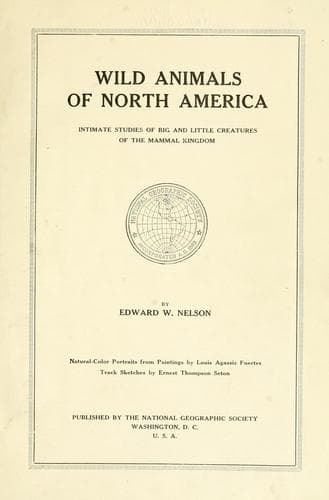
Wild Animals of North America: Intimate Studies of Big and Little Creatures of the Mammal KingdomNelson, Edward William
Science
Wild Animals of North America: Intimate Studies of Big and Little Creatures of the Mammal Kingdom
Nelson, Edward William
Mammals -- North America
The young of the cottontails are born in nests made of dead grasses
warmly lined with fur from the mother’s body. If above ground the
nest is placed in a little depression and so artfully concealed by a
covering of dead grasses that it can be discovered only by accident.
When caught, young cottontails utter little cries of alarm; the wounded
adults sometimes shriek in terror.
From the early settlement of the United States to the present day
cottontails have been so abundant that they have served as a valuable
source of our game food supply. They are hunted with guns and with
dogs, as well as being snared and trapped. Enormous numbers, running
into the millions, are killed in this country yearly, but they are so
prolific that they hold their own in a surprising degree.
Their abundance in many places, however, has made them a serious pest
to agriculture. They eat growing alfalfa and other forage plants, many
kinds of cultivated vegetables, young grape vines, and nursery stock
and even kill orchard trees by gnawing the bark from the base of the
trunks. As a result those who suffer from their depredations consider
them pests to be destroyed, while others look upon them as desirable
game animals to be protected by law.
As game animals the cottontails furnish some of the most delightful and
interesting sport available to American hunters. The scurrying zigzag
rush of a cottontail for the nearest shelter is so full of energetic
motion that it always excites a pleasurable thrill in the observer, and
even the keenest sportsman has so friendly a feeling for these little
animals that the escape of one of them from an unsuccessful shot nearly
always leaves a feeling of humorous amusement.
The cottontails have a secure place in American literature and
folklore. Who has not read the wonder stories of the adventures of
“Brer Rabbit” and ever after had a warmer feeling of fellowship for his
kind? The presence of cottontails is a source of pleasure to children
of all ages, and their disappearance from the wild life of a locality
creates a more deeply felt blank than would the passing of many a
nobler animal.
=THE MARSH RABBIT= (=Sylvilagus palustris= and its relatives)
(_For illustration, see page 511_)
The marsh rabbit, or “pontoon,” as it is known in Georgia, is a
distinctively American species allied to the cottontails, but
distinguished from them by its more heavily proportioned body, smaller
ears, shorter and slenderer legs and feet, and shorter, nearly
unicolored tail. Its only close relative in the United States is the
swamp rabbit, known in Alabama as the “cane-cutter.”
These two species appear to be members of a Tropical American group
of which other members are the wood rabbits of Mexico, Central and
South America. The distribution of the group was probably at one time
continuous, but a change to arid conditions in northeastern Mexico and
Texas isolated the two species remaining in this country.
Public-domain text, read in full here on John Shaqi.
Reviews
Reviews
No reviews yet
Be the first to share your thoughts on this work.
Elsewhere in the archive
Join the Discussion
Join the discussion
Sign in to leave a comment or review.
Sign InorCreate an account