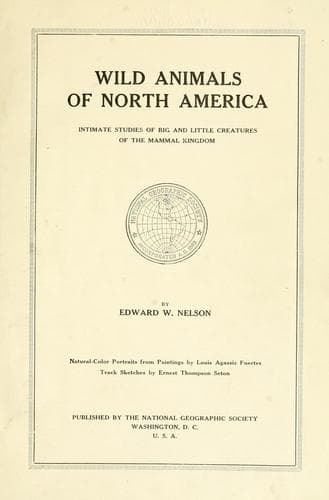
Wild Animals of North America: Intimate Studies of Big and Little Creatures of the Mammal KingdomNelson, Edward William
Science
Wild Animals of North America: Intimate Studies of Big and Little Creatures of the Mammal Kingdom
Nelson, Edward William
Mammals -- North America
Porcupine’s have an intimate connection with the romantic side of
early Indian life in eastern America. Their white quills were colored
in bright hues by vegetable dyes known to the Indians and served to
make beautiful embroidery on belts, moccasins, and other articles of
aboriginal clothing until primitive art gave way to the more tawdry
effects of trade goods.
=THE JUMPING MOUSE= (=Zapus hudsonius= and its relatives)
(_For illustration, see page 514_)
In several ways the jumping mouse is unique among American mammals.
Its strongest characteristics are a dull, rusty yellowish color, a
slender body about three inches long, a remarkably slender tail about
five inches in length, and long hind legs and feet, which are specially
developed for jumping, like those of a little kangaroo. In addition it
is provided with cheek pouches, one on each side of the mouth, in which
it gathers food to be carried to its hidden stores.
The long tail serves as a balance during its extraordinary leaps, some
of which in a single bound cover a distance of about ten feet. If by
accident one of these animals loses its tail, whenever it jumps it is
thrown into a series of somersaults, turning helplessly over and over
in the air.
The jumping mice form a small group of species and geographic
races closely similar in general appearance. They are the sole
representatives in North America of the Old World jerboas and are
themselves represented elsewhere by a single species occurring in the
interior of China. The jerboa family contains in addition many larger
and curiously diverse species distributed over a large part of Asia,
Africa, and southern Europe. Many Old World jerboas are desert animals,
some of them exact reproductions in shape and color of the kangaroo
rats of arid regions in the Western and Southwestern States and Mexico,
although they are in no way related to those animals.
Jumping mice are distributed over most of the northern parts of North
America from the Atlantic coast of Labrador to the Bering Sea coast
of Alaska, and southward to North Carolina, Illinois, New Mexico,
and California. They are nocturnal in habits and live in or near the
borders of forests, in thickets of weeds or brushwood, and in meadows
adjoining woodland areas or forest lakes. In prairie country they
occupy belts of woody growth bordering streams. In congenial locations
they range from sea level up to an altitude of 8,000 feet or more.
For winter homes they dig burrows two or three feet deep, in the lower
parts of which they excavate oval chambers and fill them with fine
grass and other soft material to make a warm nest. Other chambers
opening from these burrows serve as store-rooms for berries, seeds, and
nuts of various kinds, among which beechnuts are a favorite.
Public-domain text, read in full here on John Shaqi.
Reviews
Reviews
No reviews yet
Be the first to share your thoughts on this work.
Elsewhere in the archive
Join the Discussion
Join the discussion
Sign in to leave a comment or review.
Sign InorCreate an account