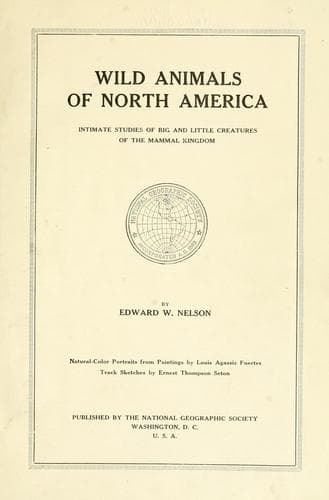
Wild Animals of North America: Intimate Studies of Big and Little Creatures of the Mammal KingdomNelson, Edward William
Science
Wild Animals of North America: Intimate Studies of Big and Little Creatures of the Mammal Kingdom
Nelson, Edward William
Mammals -- North America
The American porcupines are mainly nocturnal, although they sometimes
wander about by day. While largely arboreal in habits, they pass much
of their time on the ground and commonly have their dens in caves at
the bases of cliffs, under the shelter of large rocks, logs, piles of
brush, or in hollows at the bases of trees. They are sluggish, stupid
animals, with poor sight, and are unable to move rapidly, either in a
tree or on the ground.
Although on the ground they are extremely deliberate, in the treetops
they are even more sluggish and can be compared only with the sloth.
In consequence they are practically helpless in the presence of an
enemy except for the defense afforded by their spiny armor. That in
most cases this is effective is evidenced by their continued presence
throughout a large part of their original range where forests still
exist.
Porcupines are solitary animals, totally devoid of any qualities of
good fellowship with their kind, but the attraction of woodland camps
often brings a number together. They are exceedingly fond of salt and
persistently return to camps to gnaw logs, boards, or any other object
having a salty flavor.
They appear to be practically omnivorous so far as vegetable matter
is concerned and feed upon the bark and twigs of spruces, hemlocks,
several species of pines, cottonwoods, alders, and other trees and
bushes. In orchards and gardens near their haunts they eat apples,
turnips, and other fruits and vegetables and visit the shores of ponds
for waterlily pads and other aquatic plants growing within reach.
Ordinarily they eat patches of bark from the tree trunks, but sometimes
girdle the tree or at times denude the entire trunk. They often remain
for weeks in the top of a single tree, even in the severest winter
weather. I had a practical illustration of this on one occasion when
stormbound in a fur trader’s cabin at the head of Norton Bay, on the
north coast of Bering Sea, where a belt of spruces reached down from
the interior. We were short of meat, and when one of the Eskimos
reported that some time before he had seen a porcupine in a spruce tree
he was sent to look for it. A few hours later he returned bringing
the game, having found it in the very same tree where he had seen it
many days before, although we had just experienced a period of severe
weather, with temperatures well under 40 degrees Fahrenheit below zero.
It was on this occasion that I first learned the palatable qualities of
porcupine flesh.
Little is known definitely concerning the family life of these animals.
The young, from one to four in number, are amazingly large at birth and
appear fully armed with spines. Even before they are half grown they
adopt the solitary habit of the adults and wander forth to care for
themselves.
Public-domain text, read in full here on John Shaqi.
Reviews
Reviews
No reviews yet
Be the first to share your thoughts on this work.
Elsewhere in the archive
Join the Discussion
Join the discussion
Sign in to leave a comment or review.
Sign InorCreate an account