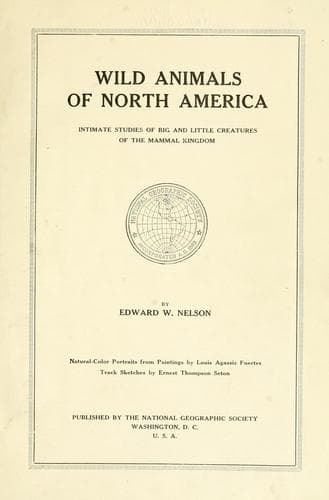
Wild Animals of North America: Intimate Studies of Big and Little Creatures of the Mammal KingdomNelson, Edward William
Science
Wild Animals of North America: Intimate Studies of Big and Little Creatures of the Mammal Kingdom
Nelson, Edward William
Mammals -- North America
The silky, as well as the other kinds of desert pocket mice, do not
drink water, and, as has been shown by experiments, they may be kept
for months in thoroughly dry sand and fed on dried seeds without any
resulting discomfort. Through the long pressure of desert environment
they have developed the power to produce sufficient water for their
physiological processes by chemical changes in the starch in their
food, which are effected in the digestive tract.
Representatives of this group of mice are almost everywhere in the
arid parts of their range, and in many sandy localities are extremely
numerous and active at night, as shown by the multitude of little
tracks in the dust at sunrise each morning. Their presence in the
desert is indicated also by the many little conical pits half an inch
or an inch deep, where they have located small seeds and dug them up.
They lie close in their burrows during cold or stormy weather,
depending on their stores for food, but are not known to hibernate,
although in the northern part of their range they are confined to their
burrows for long periods.
At one of my camps in the desert of Lower California I found the
silky and other pocket mice excessively numerous and so short of food
that they swarmed about us at night with amazing lack of fear. My
experiences with them are given in the accompanying account of the
spiny pocket mice.
The silky and other pocket mice have many enemies, among the worst of
which are the handsome little desert fox and the coyote. Others which
continually prey upon them are the badger, skunk, and bobcat, as well
as many owls.
=THE SPINY POCKET MICE= (=Perognathus hispidus= and its
relatives)
(_For illustration, see page 515_)
Pocket mice are divided into several natural groups of species, all
having certain characters in common, as a pointed head, lengthened hind
feet and legs, and external cheek pouches for carrying food. The spiny
group contains numerous species, the smallest of which is about the
size of a house mouse and the largest nearly twice that size.
They are more slenderly built than the silky species and have longer
tails, with the hairs lengthened along the terminal half, thus giving a
slightly brushy or tufted appearance. Their most striking character is
the distinctly coarser hair with long scattered guard hairs, like small
bristles, which conspicuously overlie the fur on the hinder parts of
the body and from which the common name is derived.
The distribution of the spiny forms, although nearly the same as that
of the silky ones, is a little more restricted. All belong to the arid
or desert parts of the West and Southwest, from South Dakota and middle
California southward to Michoacan, near the southern end of the Mexican
tableland, and throughout Lower California.
Public-domain text, read in full here on John Shaqi.
Reviews
Reviews
No reviews yet
Be the first to share your thoughts on this work.
Elsewhere in the archive
Join the Discussion
Join the discussion
Sign in to leave a comment or review.
Sign InorCreate an account