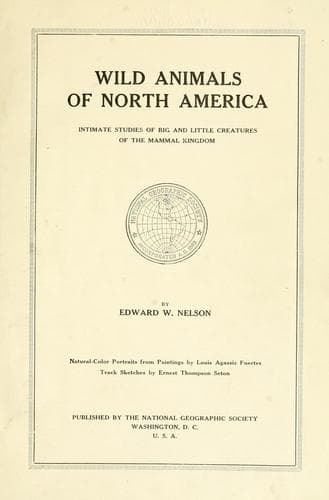
Wild Animals of North America: Intimate Studies of Big and Little Creatures of the Mammal KingdomNelson, Edward William
Science
Wild Animals of North America: Intimate Studies of Big and Little Creatures of the Mammal Kingdom
Nelson, Edward William
Mammals -- North America
Some species inhabit the scattered growth of plants in sandy areas, but
they are more generally characteristic of harder and more rock-strewn
soil, rocky mesas, and foothill slopes. There a few species make
burrows in open ground, sometimes with a single hole, but most of them
make their nests under rocks, in crevices, or in burrows sheltered
by such desert bushes as Covillea, Bursera, Olneya, Cercidium, and
mesquites.
In these shelters pocket mice make little mounds a few inches high
and ten or fifteen inches across. The mounds have several entrances
on different sides, one of which generally shows signs of recent use,
although by day it is kept closed from within by loose earth. Each of
the many-entranced dens is occupied by a single animal. Early in the
morning, before the wind fills them with dust, tiny trails are to be
seen leading from these doorways toward the nearest feeding grounds and
all about their haunts.
The spiny and the silky pocket mice, sharing much the same arid region,
have the same food plants and are preyed upon by the same enemies.
The food of these mice consists mainly of small seeds, including the
wild morning glory, wild sunflowers, wild parsnips, and a multitude of
others characteristic of the various areas they occupy.
Pocket mice are strictly nocturnal or crepuscular in habits and appear
by day only when disturbed. If the plugged entrance to a burrow is
opened, however, it will probably be quickly stopped up again from
within by the annoyed householder.
The young, in litters of from two to eight, are born at irregular times
according to the latitude and general weather conditions. In the south
at least several litters appear to be born each year, the young being
noted almost every month.
When camping alone for a few days in the desert near San Ignacio,
in the middle of the peninsula of Lower California, I had a unique
opportunity to learn something of the peculiarities of the various
pocket mice. Three species were abundantly represented, including both
the silky and the spiny kinds. They quickly learned that good hunting
could be found in and about the tents for the rice grains and other
scattered food and promptly took advantage of it.
As soon as approaching darkness began to render objects indistinct,
from their burrows among the surrounding bushes they swarmed into camp
and were busy throughout the night minutely searching the ground under
the shelter tent for every particle of food. In order to see these
interesting visitors to better advantage I placed a candle on a small
box in the middle of the tent.
Five or six individuals, representing three species, often came
within the circle of light at the same time. At first all were shy
and when I made any sudden movement would leap in every direction,
like grasshoppers, and quickly vanish. The smallest of the species, a
member of the silky group, was the shyest of all and remained timid and
reserved.
Public-domain text, read in full here on John Shaqi.
Reviews
Reviews
No reviews yet
Be the first to share your thoughts on this work.
Elsewhere in the archive
Join the Discussion
Join the discussion
Sign in to leave a comment or review.
Sign InorCreate an account