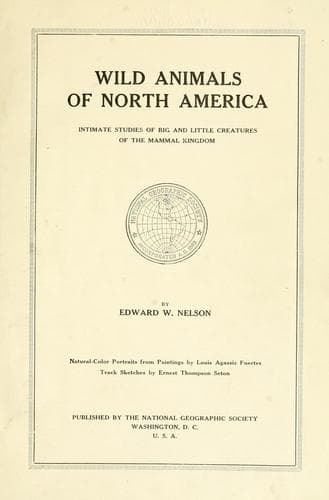
Wild Animals of North America: Intimate Studies of Big and Little Creatures of the Mammal KingdomNelson, Edward William
Science
Wild Animals of North America: Intimate Studies of Big and Little Creatures of the Mammal Kingdom
Nelson, Edward William
Mammals -- North America
The food of pocket gophers consists mainly of tubers, bulbs, and other
roots, including many of a more woody fiber. Whole rows of potatoes or
other root crops are cleaned up by the extension of tunnels along them.
Sometimes the animals follow a row of fruit trees, cutting the roots
and killing tree after tree. In grain and alfalfa fields they are great
pests, and in irrigated country their burrows in ditch banks often
cause disastrous breaks.
The big tropical species sometimes exist in such numbers as to render
successful agriculture very difficult. Sugar-cane planters in many
parts of Mexico and Central America are compelled to wage unremitting
war on them to avoid ruin. I know of an instance on a plantation
in Vera Cruz in which thousands were killed during a single season
without stopping the damage from these pests, which swarmed in from the
adjacent area.
The large external cheek pouches of pocket gophers are used solely for
gathering such food supplies as seeds, small bulbs, and sections of
edible roots or plant stems and transporting them to storage chambers
located along the sides of the tunnels. Food is placed in the pouches
by deft sidewise movements of the front feet used like hands, and so
quick are they that the motions of the feet can scarcely be detected.
The pockets are emptied by placing the front feet on the back ends
of the pouches and pushing forward, thus forcing out the contents.
In their tunnels gophers run backward and forward with almost equal
facility, the sensitive naked tail serving to guide their backward
movements.
Pocket gophers are stupid solitary little beasts, with surly
dispositions, and fight viciously when captured or brought to bay. This
attitude toward the world is justified by the host of enemies ever
ready to destroy them. Among their more active foes are snakes and
weasels, which pursue them into their tunnels; and badgers, which dig
them out of their runways.
They are also persistently hunted day and night by foxes and coyotes.
Moreover, by day various kinds of hawks watch for them to appear at the
entrances of their dens, and by night the owls, ever alert, capture
many.
When one gopher intrudes into the tunnel of another the owner at once
fiercely attacks it. In some places I have seen Mexicans take advantage
of this characteristic pugnacity by fastening the end of a long string
about the body of a captured gopher and then turning it into an
occupied tunnel, through a recently made opening. The owner, scenting
the intruder, would immediately attack him, the combatants locking
their great incisors in a bulldog grip.
The movements of the string would give notice of the encounter, and
by pulling it out steadily both animals could be drawn forth and the
enraged owner of the burrow dispatched. In this manner I have known an
Indian to catch more than a dozen gophers in a few hours.
Public-domain text, read in full here on John Shaqi.
Reviews
Reviews
No reviews yet
Be the first to share your thoughts on this work.
Elsewhere in the archive
Join the Discussion
Join the discussion
Sign in to leave a comment or review.
Sign InorCreate an account