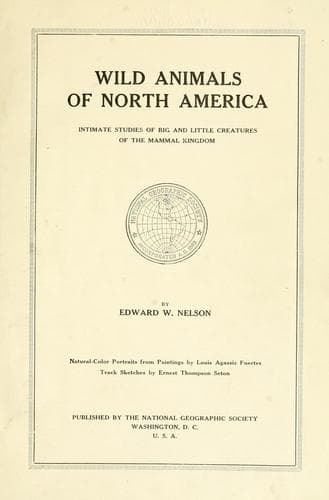
Wild Animals of North America: Intimate Studies of Big and Little Creatures of the Mammal KingdomNelson, Edward William
Science
Wild Animals of North America: Intimate Studies of Big and Little Creatures of the Mammal Kingdom
Nelson, Edward William
Mammals -- North America
Pocket gophers are active throughout the winter even in the coldest
parts of their range, but in many places must rely largely on food
accumulated in their storage chambers.
Melting snow in the mountains and in the North reveals the remains of
many tunnels made through it along the surface of the ground. These
snow tunnels are often filled for long distances with loose earth
brought up from underground, and after the snow disappears in spring
the curious branching earth forms left, winding snakelike through the
meadows, are a great puzzle to those who do not know their origin.
In a state of nature pocket gophers are constantly bringing the subsoil
to the surface and burying humus. Over an enormous area they exist in
such countless thousands that their work, like that of angleworms,
is often of the most beneficial character. On bare slopes, however,
their work is highly injurious, as it greatly increases erosion of the
fertile surface soil and thus has its direct influence in changing
world contours.
When civilized man arrives in their haunts and upsets natural
conditions with cultivated crops the new food supply stimulates an
increase in the gopher population and their activities immediately
become excessively destructive and necessitate unremitting warfare
against them.
=THE KANGAROO RATS= (=Dipodomys spectabilis= and its
relatives)
(_For illustration, see page 518_)
The desert regions of western North America have developed several
peculiar types of mammals, and among them are none handsomer or more
interesting than the kangaroo rats. These rodents, despite their name,
are neither kangaroos nor rats, but are near relatives of the pocket
mice, which share their desert haunts.
All are characterized by a kangaroo-like form, including small fore
legs and feet, long hind legs and feet for jumping, and a tail longer
than the body to serve as a balance. In addition, they have large,
prominent eyes and are provided with skin pouches on each side of the
mouth for use in holding food to be carried to their store chambers.
The color pattern, like the form, of the kangaroo rats is practically
uniform throughout the group. Both are well shown in the accompanying
plate of _Dipodomys spectabilis_, the largest and most strongly marked
species. Its total length is from 12 to 14 inches; most of the other
species are much smaller.
Kangaroo rats of many species are distributed over most of the arid
and semiarid regions of the United States and Mexico, from Nebraska,
Oklahoma, and the Gulf Coast of Texas west to the Pacific coast,
and from Montana and Washington southward to the Valley of Mexico
and throughout Lower California. They are especially numerous in the
southwestern deserts, where they are the oddest and most picturesque of
animals.
Public-domain text, read in full here on John Shaqi.
Reviews
Reviews
No reviews yet
Be the first to share your thoughts on this work.
Elsewhere in the archive
Join the Discussion
Join the discussion
Sign in to leave a comment or review.
Sign InorCreate an account