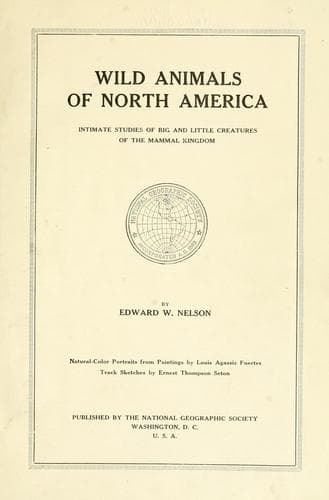
Wild Animals of North America: Intimate Studies of Big and Little Creatures of the Mammal KingdomNelson, Edward William
Science
Wild Animals of North America: Intimate Studies of Big and Little Creatures of the Mammal Kingdom
Nelson, Edward William
Mammals -- North America
The banded lemmings form a strongly marked group, containing a number
of species inhabiting circumpolar regions. In North America they
occur nearly everywhere in the arctic and subarctic parts, including
Greenland, most of northern Canada, including the Arctic islands, and a
large part of Alaska, including some of the Aleutian Islands.
They range as far northward as vegetation affords them a proper food
supply and have been well known to many of the explorers of those
stern northern wilds. To the southward they extend into the subarctic
northern forests, where they usually keep to the open barren areas.
Not much is known of their life histories on this continent. They are
mainly nocturnal and live in burrows from two to three feet long,
ending with a nest chamber four or five inches in diameter, warmly
lined with grass and moss. Near the nest there is usually a branch
burrow a foot or more long which is used for sanitary purposes and as a
place of refuge when the main burrow is invaded.
In the nests during early summer litters generally containing about
three young are brought forth. Ordinarily the burrows open in
unsheltered places, but in wooded regions may be under a log or beneath
a bush or the roots of a tree. No runways lead out from the burrows as
is customary with many of their relatives. They are active throughout
the winter, making many tunnels along the surface of the ground under
the snow, which are revealed when it melts in spring.
These surface tunnels are their foraging roads, safe from most of the
fierce storms which rage overhead. At times, however, the snowy shelter
is blown away or some other cause brings the lemmings to the surface,
where they blunder aimlessly about, soon to be captured by some enemy
or to perish from the cold. As their infrequent appearance on top of
the snow is usually during storms, the Alaskan Eskimos have a legend
that these white lemmings live in the land above the stars and descend
in a spiral course to the earth during snowstorms.
Although banded lemmings never become so extraordinarily numerous over
great areas as the brown species, they become very abundant at times in
the barren grounds of Canada and the Arctic islands and migrate from
one part of their range to another. The best observation in regard to
this was made by Rae in June at the mouth of the Coppermine River. On
the west bank of the river north of the Arctic Circle he encountered
thousands of them speeding northward.
The ice on some of the smaller streams had broken up and he was amused
to see the little animals running back and forth along the banks
looking for a smooth place in the stream, indicating a slow current,
where they could swim across. Having found such a place, they at once
jumped in and swam quickly to the opposite side, where they climbed out
and, after shaking themselves like dogs, continued their journey as
though nothing had happened.
Public-domain text, read in full here on John Shaqi.
Reviews
Reviews
No reviews yet
Be the first to share your thoughts on this work.
Elsewhere in the archive
Join the Discussion
Join the discussion
Sign in to leave a comment or review.
Sign InorCreate an account