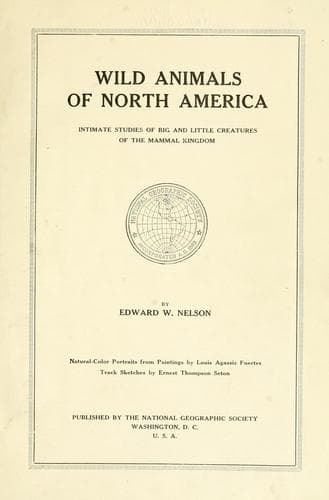
Wild Animals of North America: Intimate Studies of Big and Little Creatures of the Mammal KingdomNelson, Edward William
Science
Wild Animals of North America: Intimate Studies of Big and Little Creatures of the Mammal Kingdom
Nelson, Edward William
Mammals -- North America
While occupied in this rivalry for food they became surprisingly
pugnacious. If one was working at the rice pile and another rat or a
pocket mouse approached, it immediately darted at the intruder and
drove it away. The mode of attack was to rush at an intruder and,
leaping upon its back, give a vigorous downward kick with its strong
hind feet. Once I saw a pocket mouse kicked in this way. It was knocked
over and for a minute or more afterwards ran about in an erratic
course, squeaking loudly as though in much pain.
Sometimes the pursuit of one kangaroo rat by another continued for
twenty yards or more. By the time the pursuer returned another would
be at the rice pile and it would immediately dash at the victor of
the former fray and drive him away. In this way there was a constant
succession of amusing skirmishes.
Sometimes an intruder, bolder than the others, would run only two or
three yards and then suddenly turn and face the pursuer, sitting up on
its hind feet like a little kangaroo. The pursuer at once assumed the
same nearly upright position, with its fore feet close to its breast.
Both would then begin to hop about watching for an opening. Suddenly
one would leap at the other, striking with its hind feet exactly like
a game cock. When the kick landed fairly on the opponent there was a
distinct little thump and the victim rolled over on the ground. After
receiving two or three kicks the weaker of the combatants would run
away.
The thump made by the kick when they were fighting solved the mystery
which had covered this sound heard repeatedly during my nights at this
camp. The morning light revealed a multitude of little paired tracks
made by the combatants in these battles. Such tracks in the sand have
been referred to as the “fairy dances” of these beautiful little
animals, but the truth revealed proves them to be really “war dances.”
=THE BANDED LEMMING= (=Dicrostonyx nelsoni= and its relatives)
(_For illustration, see page 519_)
Banded lemmings are unique among the mouse tribe in their change from
the rufous brown, or gray summer coat to pure white in winter. With
the assumption of the white winter fur a thick, horny, padlike growth
develops on the underside of the two middle claws of the front feet,
which is molted in spring when the winter coat is lost. For an animal
living in the far North the usefulness of a white coat in winter is
evident, but no good reason is apparent for these curious claw-pads.
The summer coat varies remarkably in color and color pattern, and many
of the lemmings in their beautiful shades of chestnut, browns, or grays
are very handsome. They are more heavily proportioned than field mice
and the very long fluffy fur, which completely conceals the rudimentary
ears and tail, tends to exaggerate their size.
Public-domain text, read in full here on John Shaqi.
Reviews
Reviews
No reviews yet
Be the first to share your thoughts on this work.
Elsewhere in the archive
Join the Discussion
Join the discussion
Sign in to leave a comment or review.
Sign InorCreate an account